
Work Addiction in High Achievers: Breaking the Cycle Without Losing Your Empire

Work addiction - a compulsive need to work - affects many high achievers, often disguised as dedication. It’s driven by perfectionism, identity tied to achievements, and environments that glorify hustle. But the consequences are severe: chronic stress, health issues, strained relationships, and reduced productivity.
Here’s what you need to know:
- Key Signs: Constant preoccupation with work, guilt during downtime, and inability to delegate.
- Risks: 9.7% of U.S. full-time employees and up to 25% in high-stress fields show signs of work addiction.
- Recovery Tools: Self-assessment tools (e.g., BWAS, WART), therapy (CBT, ACT), mindfulness practices, and setting boundaries.
- Treatment Options: Confidential executive rehab programs offer tailored care, privacy, and work-life reintegration strategies.
Recovery doesn’t mean losing your edge - it’s about working smarter, not harder, while safeguarding your health and leadership potential.
Recognizing and Diagnosing Work Addiction
Behavioral and Psychological Warning Signs
Work addiction can be tricky to spot because it often masquerades as dedication or ambition. One of the first red flags is a compulsive need to work - not for enjoyment or achievement, but because stopping feels impossible.
Certain behaviors stand out. For instance, you might find yourself mentally drafting tomorrow's to-do list during family dinner, even if you're physically present. Another common sign is "leisure illness" - experiencing headaches, fatigue, or flu-like symptoms during downtime, like weekends or vacations, when work slows down.
People prone to work addiction often struggle with delegation, not because their teams lack skill but because handing off tasks feels risky. This mindset can create a cycle where self-worth becomes tied to output. Studies show that work addiction affects 23% to 25% of professionals in high-stress fields like law, medicine, and therapy.
Spotting these patterns early can encourage self-reflection and the use of structured evaluation tools.
Self-Assessment Tools and Clinical Evaluations
Two widely recognized tools can help assess work addiction:
| Tool | Length | What It Measures |
|---|---|---|
| Bergen Work Addiction Scale (BWAS) | 7 items | Salience, mood modification, tolerance, withdrawal, conflict, relapse, and health impact |
| Work Addiction Risk Test (WART) | 25 items | Compulsive tendencies, need for control, impaired communication, and self-worth |
The BWAS focuses on whether work dominates your life, exceeds your intentions, and impacts your health. Meanwhile, the WART dives deeper, exploring perfectionism and the inability to disconnect. These tools don’t require a clinician and are great starting points for personal reflection.
Another helpful step is to ask for input from someone close to you. Workaholics often fail to see their own struggles, but family or friends may notice the warning signs much earlier.
"Workaholics behave as other people with addictions behave, and they often need help addressing their addictive behaviors." - J. Adam Rindfleisch, MPhil, MD, VA Whole Health Library
Although work addiction isn’t officially recognized in the DSM-5-TR or ICD-11, clinicians can use these tools to identify patterns that contribute to burnout, anxiety, and depression.
Once you've identified the issue, the next step is to explore treatment options while protecting your privacy.
Protecting Privacy While Seeking Help
For executives or professionals in high-profile roles, seeking help can feel risky. Concerns about reputational damage make privacy a key consideration during recovery. Thankfully, there are discreet options available.
Start by exploring your organization’s Employee Assistance Program (EAP). These programs often provide confidential assessments and support without involving HR or management. If you need more intensive care, executive-focused residential programs in remote areas, like Sedona, Arizona, offer a chance to step away from your usual environment. This reduces the risk of running into colleagues or clients.
Private support groups also prioritize confidentiality through strict application processes. Additionally, setting clear digital boundaries - such as avoiding work emails after a specific time - can create space for recovery activities without drawing attention.
Breaking the Cycle: Evidence-Based Strategies
Shifting Your Mindset Around Success
Take a moment to question the beliefs that fuel your overwork. Work addiction isn't about ambition; it's often a response to fear and unresolved anxiety. As Sea Recovery puts it:
"The compulsion to work is not about success - it is about survival." - Sea Recovery
One way to begin shifting this mindset is through identity work - learning to separate your sense of self from your professional achievements. A simple yet revealing exercise is to write your own eulogy, but from the perspective of your family instead of colleagues. What do you truly want to be remembered for? Many find that their current priorities don’t align with their deeper values.
Therapeutic approaches like Cognitive Behavioral Therapy (CBT) and Acceptance and Commitment Therapy (ACT) can help reframe these patterns. CBT challenges perfectionist thinking, while ACT focuses on connecting your work to personal values rather than external validation. Together, they encourage a shift from "achieve more" to "work with purpose."
Here’s a critical statistic to consider: research shows that productivity per hour drops significantly after 50 hours of work per week. In fact, working 70 hours achieves almost the same output as 55 hours. In other words, overworking doesn’t lead to greater results - it just takes a bigger toll.
Mindfulness and Stress Regulation for Busy Executives
For busy professionals, mindfulness isn’t about spending hours meditating. It’s about learning to regulate your nervous system to move out of chronic "fight or flight" mode and into a state of calm focus.
Practical tools that fit into packed schedules include:
- Breathwork to manage stress during high-pressure moments.
- A short morning grounding routine like a 10-minute walk or reflective journaling before diving into emails.
- An evening reflection period to intentionally close out the workday.
These practices aren’t indulgences - they’re tools that enhance focus, creativity, and leadership.
For a deeper reset, somatic techniques like Tension & Trauma Releasing Exercises (TRE) help release stress stored in the body. Cold therapy methods, such as the Wim Hof Method, can also reduce inflammation and boost mental clarity. These approaches bypass the mind and target the physical effects of chronic stress directly.
Once your body is in a calmer state, it becomes easier to set boundaries and delegate tasks effectively.
Setting Boundaries and Delegating Work
Setting boundaries doesn’t mean working less - it means working smarter.
"Boundaries don't signal lack of commitment - they signal strategic thinking." - James Franklin, Executive Coach
A practical starting point is to establish a "digital sunset": no work-related communication after 7 p.m. or before 7 a.m. This gives your nervous system a chance to unwind and breaks the cycle of compulsive email-checking that keeps stress levels high. Pair this with a short transition ritual - a specific activity like a walk or listening to a favorite playlist - that signals the end of the workday.
Delegation can be more challenging. High achievers often avoid it, not because their teams lack capability, but because letting go of tasks can trigger anxiety. Interpersonal Psychotherapy (IPT) is a tool many executives use to build trust in their professional relationships, making delegation feel less risky. Start small: choose a recurring task to delegate this week. The discomfort you feel afterward can reveal where deeper work is needed.
Fighting Workaholism: You Are Not a Success Machine
sbb-itb-4b13a7c
Luxury Rehabilitation Options for Executives
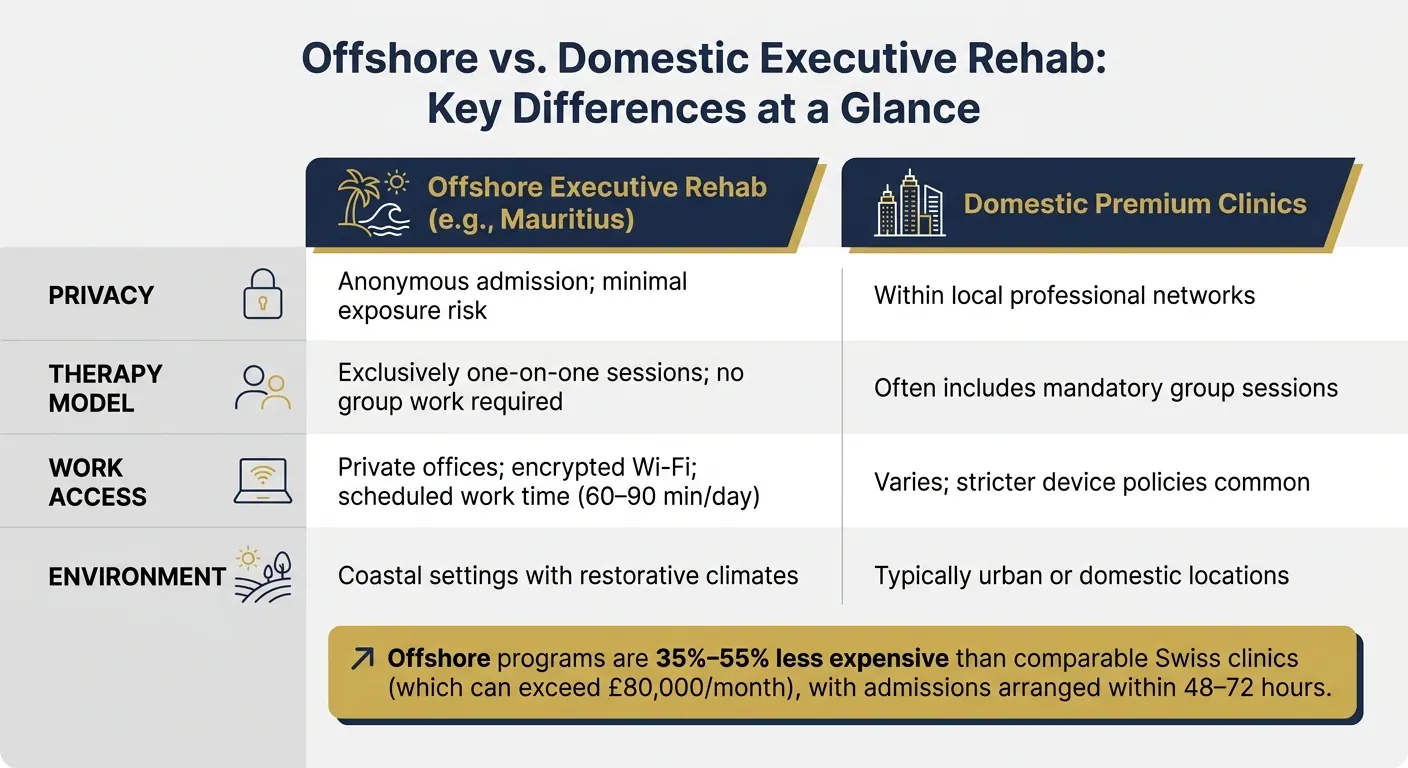
Offshore vs. Domestic Executive Rehab: Key Differences at a Glance
What Executive Treatment Programs Offer
When self-help methods fall short, structured clinical care becomes the logical next step. For executives, this means treatment programs tailored to their unique circumstances rather than generic solutions.
Executive rehab programs go far beyond the basics. They prioritize privacy and reputation, offering one-on-one sessions with senior clinicians. These programs blend medical care with complementary therapies like acupuncture, gourmet dining, spa treatments, and yoga to support mental and physical recovery.
Work addiction often comes with other challenges. Senior professionals frequently face dual diagnoses, such as burnout, anxiety, or dependency on medications used to maintain high performance.
"Recovery for senior leaders requires both medical precision and uncompromising privacy." - Dr. Siddick Maudarbocus, Founder and Addiction Medicine Specialist, Les Mariannes
One prominent executive program reports a 94% success rate from more than 3,500 cases. This statistic points to the effectiveness of personalized and confidential care.
Discreet and Flexible Treatment Models
Executive rehab programs are designed with flexibility and discretion in mind, addressing the unique needs of high-level professionals.
For many executives, the challenge isn't finding help - it's finding help that integrates seamlessly into their demanding lives. Privacy is paramount. Every staff member, from clinicians to support personnel, adheres to strict NDAs to ensure confidentiality. Admission can often be arranged under an alias, and private airport transfers in unmarked vehicles further protect anonymity.
These programs also allow executives to stay connected to their work in a controlled manner. Facilities often provide private offices with encrypted Wi-Fi and limited "business windows" (usually 60 to 90 minutes daily) to handle essential tasks without fueling workaholic tendencies.
"The program eliminates crisis without enabling workaholism, differentiating recovery from relapse." - Les Mariannes
Seeking treatment abroad adds another layer of privacy. Facilities in places like Mauritius offer a buffer from professional networks, competitors, and media scrutiny. These offshore programs are often 35% to 55% less expensive than comparable Swiss clinics, which can cost over £80,000 per month. Admissions can frequently be arranged within 48 to 72 hours, offering a quick and discreet path to recovery.
| Feature | Offshore Executive Rehab (e.g., Mauritius) | Domestic Premium Clinics |
|---|---|---|
| Privacy | Anonymous admission; minimal exposure risk | Within local professional networks |
| Therapy Model | Exclusively one-on-one sessions; no group work required | Often includes mandatory group sessions |
| Work Access | Private offices; encrypted Wi-Fi; scheduled work time | Varies; stricter device policies common |
| Environment | Coastal settings with restorative climates | Typically urban or domestic locations |
How Leading Rehabs Helps You Choose the Right Program

Navigating the world of luxury rehab can be overwhelming, but Leading Rehabs simplifies the process by offering detailed profiles of top-tier facilities. Their curated profiles focus on the needs of ultra-high-net-worth individuals, providing a clear overview of therapy options, conditions treated, and privacy measures.
Leading Rehabs bridges the gap between clinical care and executive responsibilities by consolidating key details like privacy protocols, business accommodations, and therapy models. This makes it easier to compare facilities without wading through vague marketing materials or making blind inquiries.
Aftercare is another critical factor. The best programs extend their support for 3 to 12 months through telehealth therapy, recovery coaching, and structured plans for reintegrating into work. This ensures that the progress made during treatment leads to sustainable, healthier leadership in the long term.
Maintaining Recovery and Long-Term Success
Building a Personal Recovery Plan
Leaving treatment is just the first step in reshaping your work-life balance. A good starting point is identifying your personal triggers - those specific situations, emotions, or pressures that can lure you back into overworking. For executives, this might include looming deadlines or unstructured free time.
Another key aspect of long-term recovery is rebuilding your identity beyond work. As mentioned earlier, work addiction often stems from equating self-worth solely with productivity. Acceptance and Commitment Therapy (ACT) can be particularly helpful here, offering tools to align your daily habits with your core values rather than fear-driven behaviors. Partnering with a recovery coach can also provide ongoing support, offering structured accountability as you face the pressures of everyday life. Once you’ve built a recovery plan, you can use these lessons to enrich your leadership approach for lasting change.
Bringing Healthier Practices into Your Leadership Style
Recovery doesn’t mean stepping away from leadership - it’s an opportunity to lead with greater clarity and purpose. When stress is better managed, your thinking becomes sharper, and decision-making improves. Start by setting firm work-hour limits to create clear boundaries. You might also assign tasks more intentionally and incorporate a grounding morning routine, like journaling for 15–20 minutes or going for a brisk walk. These small adjustments can interrupt the cycle of urgency that often fuels workaholism. By respecting your own boundaries, you set a positive example for your team, encouraging a healthier workplace culture that helps prevent burnout. These changes not only enhance your well-being but also strengthen the recovery foundation you’ve worked hard to build.
Tracking Progress After Recovery
To ensure your recovery translates into lasting success, it’s essential to track progress in both personal and professional areas. Here are some key metrics to monitor:
| Area | What to Track | Healthy Benchmark |
|---|---|---|
| Sleep | Hours per night, sleep quality | 7–9 hours consistently |
| Work Hours | Daily and weekly totals | Within agreed limits |
| Emotional Availability | Quality time with family/friends | Regular, undistracted connection |
| Physical Health | Exercise frequency, digestion, energy | Consistent movement; no chronic fatigue |
| Work Compulsion | Frequency of checking emails outside set hours | Declining frequency over time |
Review these indicators monthly with a therapist or coach to stay on track. If you notice one area slipping, treat it as an early warning sign to address the underlying issue before it becomes a bigger problem. Regular check-ins help ensure you maintain balance and avoid falling back into old patterns.
Conclusion: Overcoming Work Addiction Without Losing Your Edge
Many high achievers worry that stepping back from overwork might mean falling behind. But the truth? The opposite often happens. A calm, regulated nervous system doesn’t slow you down - it makes you sharper.
"When your nervous system is regulated, creativity, clarity, and leadership often improve significantly." - Sea Recovery
Work addiction isn’t about striving for greatness; it’s a survival mechanism. Studies show that understanding this difference is the first meaningful step toward change.
Recovery doesn’t clash with professional success. Recognizing the signs, creating boundaries, delegating intentionally, and following structured aftercare can make you a more effective leader. These shifts not only support your well-being but also enhance your ability to lead and succeed. By building healthier habits, you can sustain your ambition on a stronger, more balanced foundation.
Your drive doesn’t disappear - it thrives when built on stability.
FAQs
How do I know if I’m a workaholic or just ambitious?
The main distinction comes down to the impact your work habits have on your life. If your drive to work becomes compulsive and starts harming your health or relationships, it’s a sign of workaholism. In contrast, ambition reflects a healthy desire for success that doesn’t cause such negative effects. Take a closer look at how your work affects your well-being and personal life to figure out which category you fall into.
What boundaries work for leaders with nonstop demands?
Leaders can set effective boundaries by first identifying their personal limits and sticking to them. This might include defining specific work hours and ensuring they communicate their availability clearly to their team. By doing so, they not only protect their own well-being but also set an example for others.
Creating a supportive work environment is equally important. Leaders can achieve this by modeling healthy boundary-setting behaviors themselves and pushing for organizational policies that respect and reinforce these limits. This approach helps cultivate a culture where everyone feels empowered to maintain a healthy balance between work and personal life.
Can executive rehab treat work addiction without risking my privacy?
Yes, executive rehab programs can help tackle work addiction while safeguarding your privacy. These facilities implement strict confidentiality practices, such as requiring staff to sign NDAs, offering anonymous admission processes, using encrypted communication methods, and employing secure treatment protocols to ensure your identity and personal details remain protected.