
Survivor Guilt in Wealth: Healing the Psychological Burdens of Success

Survivor guilt in wealthy individuals arises from the emotional struggles tied to financial privilege. It’s the internal conflict between outward success and feelings of unease, often leading to imposter syndrome, social isolation, and chronic stress. This guilt can stem from family expectations, societal scrutiny, and the pressure to maintain wealth, leaving many feeling disconnected or trapped.
Key points:
- Common symptoms: Imposter syndrome, emotional withdrawal, and overworking.
- Causes: Family dynamics, societal judgment, and inherited roles.
- Effects: Stress, health problems, and strained relationships.
- Solutions: Therapy, mindfulness, and self-compassion exercises.
Luxury rehab centers offer specialized treatments like CBT, mindfulness, and somatic therapies to address these challenges. Practical strategies, such as self-compassion techniques and journaling, can also help individuals regain emotional balance and redefine their relationship with success.
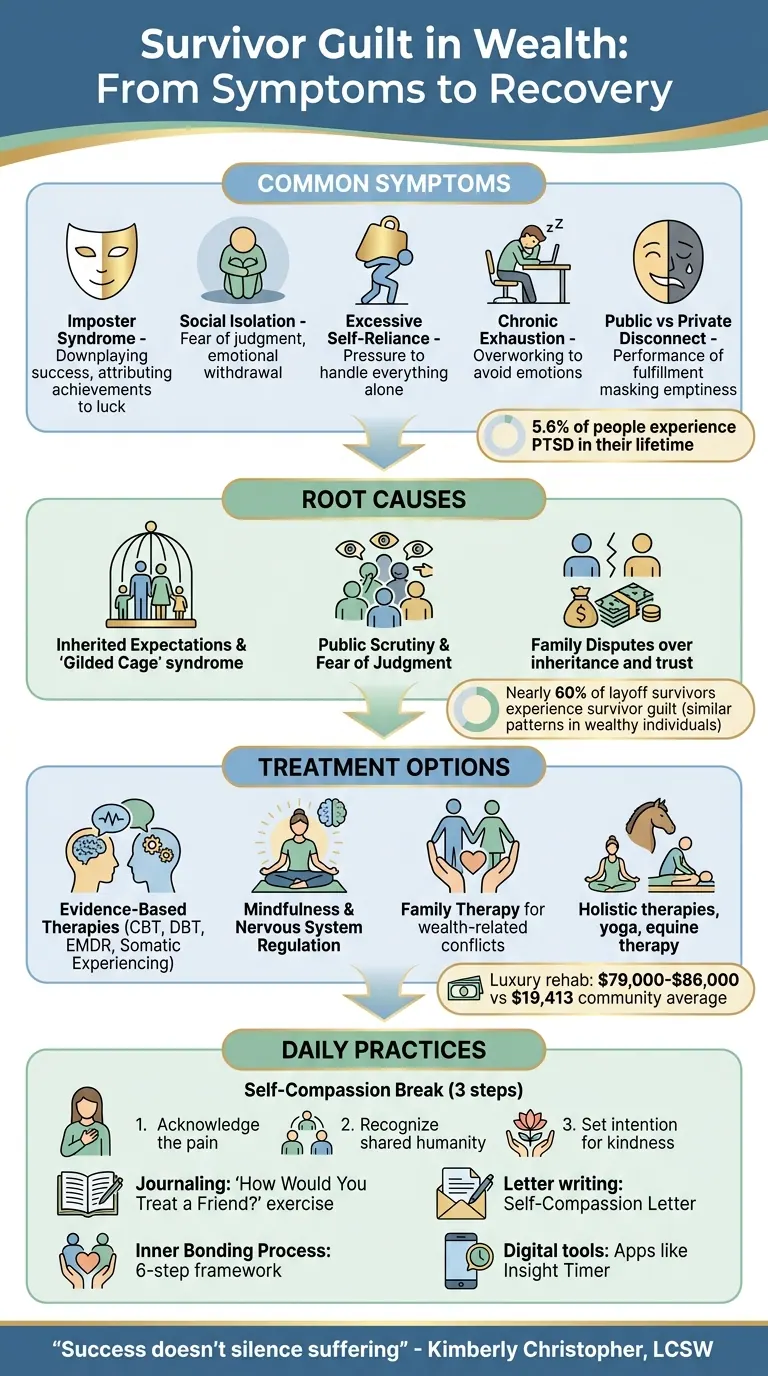
Understanding and Healing Survivor Guilt in Wealth: Symptoms, Causes, and Treatment Pathways
Financial Survivor’s Guilt: What it is and How to Cope
sbb-itb-4b13a7c
Symptoms and Emotional Effects of Survivor Guilt
Building on the understanding of survivor guilt in the context of success, the symptoms highlight how internal struggles can shape behavior and impact overall well-being.
Common Signs of Wealth-Related Guilt
Survivor guilt among wealthy individuals often manifests in specific ways. One of the most prevalent signs is imposter syndrome. High achievers frequently downplay their success, attributing it to luck or external factors rather than their own efforts. This persistent sense of insecurity lingers, regardless of how much they achieve.
Another hallmark is social isolation. Many affluent individuals report feeling they lack a safe space to express vulnerability without fear of judgment. They worry their struggles might be perceived as ungratefulness, which leads to emotional withdrawal. Over time, relationships can start to feel transactional, eroding trust and making it harder to form genuine connections.
Excessive self-reliance is another common trait. The pressure to "handle everything alone" often stems from a fear of appearing vulnerable. While this approach may seem like strength, it can lead to emotional exhaustion. The inability to seek or accept help reinforces isolation and contributes to both mental and physical strain.
The Emotional Toll of Financial Success
The psychological burden of wealth-related guilt goes far beyond fleeting discomfort. Many high-net-worth individuals experience chronic exhaustion, which they often mask with relentless productivity. Overworking becomes a way to avoid confronting unresolved emotions, but it can result in sleep problems, mood swings, and even physical health issues.
A striking disconnect between public image and private reality adds to the emotional strain. Kimberly Christopher, LCSW, describes this as a unique kind of pain:
"The absence of aliveness, the constant performance of fulfillment, is its own kind of wound".
This gap between the outward appearance of success and the internal reality of emptiness can severely impact mental health.
Existential dread frequently surfaces after reaching significant financial goals. When self-worth is tied solely to achievement, the question "What’s next?" can trigger a profound crisis of meaning. Survivor guilt is also recognized as a key symptom in conditions like PTSD, which affects an estimated 5.6% of people in their lifetime. For wealthy individuals, their nervous system often remains in a constant state of high alert - a normalized response in elite environments. However, this prolonged state of stress can lead to serious cardiovascular and inflammatory health problems. Understanding these deep-rooted effects is crucial for addressing and managing this complex guilt.
What Causes Survivor Guilt in Affluent People
Survivor guilt among affluent individuals often emerges from a combination of family expectations and societal narratives that shape their experiences.
Family Relationships and Inherited Expectations
For many, inherited wealth can feel like living in a "Gilded Cage" - a term that describes the psychological burden of family history and unspoken duties. As Paracelsus Recovery puts it:
"Inheriting significant wealth often comes with implicit obligations, expectations, and identity constraints that can feel like a gilded cage."
This notion resonates with many heirs who feel trapped in roles that were scripted long before they were even born. A striking example is Bill Gates’ decision in March 2026 to leave his children a modest inheritance. His daughter welcomed this choice, describing it as a release from the crushing weight of expectations. Similarly, Prince Harry’s departure from royal duties highlights the intense pressure of inherited roles and the yearning for personal freedom.
While family dynamics set the stage for these struggles, societal influences further amplify the emotional toll.
Social and Cultural Influences
Outside the family sphere, societal attitudes can deepen feelings of guilt. Research reveals parallels between affluent individuals and layoff survivors, with nearly 60% of the latter experiencing survivor guilt. In the case of the wealthy, constant public scrutiny magnifies every decision, making any misstep feel monumental. This fear of judgment often leads to self-censorship, as many worry about being labeled as unworthy or out of touch.
Eloise Casal sheds light on another layer of complexity:
"Wealth often amplifies family conflicts. Disputes over inheritance, trust issues, or differing financial priorities can strain familial relationships, contributing to emotional distress."
These external pressures can erode personal relationships, turning them into transactional interactions. This dynamic often leaves affluent individuals feeling isolated, perpetuating a cycle of guilt and emotional withdrawal.
Treatment Options at Luxury Rehabilitation Centers
Luxury rehab centers recognize that survivor guilt among affluent individuals often requires more than standard therapy. These facilities focus on addressing the underlying causes of guilt, frequently tied to early experiences of financial instability or emotional neglect. These "original wounds" can manifest as guilt and a need for hyper-control in adulthood, which are treated as trauma responses.
The therapy process often involves "rewiring" the nervous system to help clients escape the chronic fight-or-flight state. Paracelsus Recovery explains this dynamic:
"Hyper-control can be a trauma response, often forged in chaos, loss, or betrayal, and later reinforced by extreme responsibility and visibility."
These high-end treatment programs come at a premium, with costs ranging from $79,000 to $86,000 per stay at facilities like CMC Berkshires - far above the $19,413 community average. This pricing reflects the tailored nature of therapy, designed to meet the specific challenges faced by ultra-high-net-worth individuals, including the pressures of wealth and public scrutiny.
Mindfulness and Emotional Control Methods
Mindfulness techniques play a key role in helping clients recalibrate emotionally. These practices are especially effective for addressing the "fear of decline" and the stress tied to preserving wealth. By encouraging reflection beyond material success, mindfulness helps individuals pinpoint guilt triggers and develop healthier emotional habits.
Eloise Casal from New Life Rehab highlights this approach:
"Luxury rehab centres teach stress management techniques, including mindfulness, deep breathing, and time management skills, empowering clients to handle pressures constructively."
The goal is to widen the "window of tolerance", enabling clients to cope with uncertainty without resorting to micromanagement or constant vigilance. Clients learn to recognize moments when their nervous system signals a need for control and can then use mindfulness techniques to respond in healthier ways.
Counseling Programs for Wealth-Related Issues
Counseling at these facilities blends evidence-based therapies like Cognitive Behavioral Therapy (CBT) and Dialectical Behavior Therapy (DBT) with treatments tailored to wealth-specific challenges. These programs address issues such as post-success depression - the emptiness that can follow major financial achievements - as well as perfectionism and the relentless pressure to sustain status.
Family therapy is another critical component, helping to resolve conflicts over inheritance and trust issues, which often exacerbate survivor guilt. Some centers, like RCA at Monroeville, offer specialized tracks such as "Balance" for co-occurring mental health conditions and "WorkFlex" for clients who need to stay professionally active during treatment.
Paracelsus Recovery redefines the concept of control in therapy:
"True control lies in sovereignty over your inner world."
These tailored therapies are designed to build emotional resilience and provide long-term support for clients navigating the unique pressures of affluence.
Building Supportive Recovery Frameworks
Recovery frameworks at luxury rehab centers emphasize processing grief and loss through somatic therapies, which help clients confront the emotional complexities of their success. Holistic practices like yoga and equine therapy are integrated to support physical, emotional, and spiritual healing.
A major focus is on learning to delegate, often referred to as strengthening the "trust muscle." This process involves embracing vulnerability, which Paracelsus Recovery describes as fundamental:
"Authentic human connection requires vulnerability, and vulnerability requires the willingness to not know, to not control, to not have the answer."
Clients are also encouraged to practice self-compassion, treating themselves with the same kindness they might extend to others. The overarching message is that true strength comes from flexibility and resilience, rather than rigid control or the relentless pursuit of wealth. Aftercare programs provide ongoing therapy and support groups to help clients maintain their progress as they reenter high-stress environments.
Practical Strategies and Resources for Recovery
Beyond professional treatment, there are simple yet powerful strategies that can help individuals work through survivor guilt and restore emotional balance. These approaches build on mindfulness and counseling techniques, emphasizing the importance of self-compassion. Interestingly, research highlights that while people often find it easier to extend compassion to others, practicing it for oneself can significantly improve overall life satisfaction.
Daily Exercises for Self-Awareness and Growth
One effective method to ease guilt and stress is the Self-Compassion Break, which follows three straightforward steps:
- Acknowledge the pain: Say something like, "This is a moment of suffering" or "This hurts."
- Recognize shared humanity: Remind yourself, "Suffering is a part of life" or "I'm not alone."
- Set an intention for kindness: Use phrases such as, "May I be patient with myself" or "May I forgive myself."
This practice interrupts the cycle of self-criticism that fuels guilt and shame, helping to foster a kinder internal dialogue.
Another helpful exercise is the "How Would You Treat a Friend?" practice. Write down the advice or support you’d offer a friend experiencing guilt over their success. Then, compare it to how you speak to yourself. Often, you’ll notice a stark difference in tone. To take it a step further, try writing a Self-Compassion Letter from the perspective of a loving and nonjudgmental friend who fully accepts your achievements and struggles.
The Inner Bonding Process is another valuable framework for managing emotional pain. It involves six steps: first, allow yourself to feel the pain. Then, shift your focus to learning about the thoughts behind it. Identify any false beliefs you might hold, and engage in a dialogue with your higher self to gain a more loving perspective. From there, take a compassionate action based on these insights, and finally, reflect on whether this action helped ease your guilt or shame.
For those looking for accessible tools to complement in-person therapy, digital resources can be incredibly helpful. For example, the Insight Timer app offers specialized courses like "Worthy: Mindfulness for Survivors", which target the psychological roots of survivor guilt.
These practices, when integrated into daily life, can strengthen emotional resilience and work hand-in-hand with professional therapeutic techniques.
Books on Wealth and Mental Health
Books can also provide valuable insights during the recovery process. For example, Deeper Dating by Ken Page delves into the concept of inner bonding and the challenge of embracing parts of yourself that you might otherwise view as flaws. Additionally, Paracelsus Recovery offers curated educational materials that explore the intersection of wealth, trauma, and mental health. These resources highlight the importance of emotional strength and resilience, focusing on internal growth rather than external control.
Together, these tools and readings can guide individuals toward a healthier relationship with their emotions and their success.
Conclusion: Moving Forward with Professional Support
Survivor guilt tied to wealth isn’t something you have to deal with on your own. As Kimberly Christopher, LCSW, puts it, "Success doesn't silence suffering." Achieving financial success can bring emotional challenges that often require specialized care to address.
Seeking professional support can provide a safe and non-judgmental space to explore these feelings. Luxury rehabilitation centers offer tailored care, ensuring privacy through encrypted communication. Therapies like EMDR, Somatic Experiencing, and Internal Family Systems are particularly effective in helping individuals release stress and shift from a constant state of performance to one of true rest and connection. These approaches, often found in high-end rehabilitation settings, are designed to address the unique psychological challenges that can accompany wealth.
But it’s not just about managing symptoms. These interventions can help you reconnect with who you are at your core, beyond societal expectations or external pressures. As Kimberly Christopher wisely notes, "Wholeness Is the Ultimate Wealth." True fulfillment lies in nurturing meaningful relationships, embracing your emotions, and living in alignment with your deepest values.
Moving forward requires compassionate accountability - learning to use wealth in a way that aligns with purpose rather than perpetuating guilt. Whether through ongoing therapy, structured aftercare, nervous system regulation techniques, or reflective practices, the path ahead involves letting go of the myth of absolute self-reliance and building secure, supportive connections with others.
FAQs
How do I know if what I’m feeling is survivor guilt or just stress?
Survivor guilt arises when someone lives through a traumatic event where others did not, often leaving them with lingering feelings of guilt, sadness, or anxiety. In contrast, stress is typically a short-term reaction to external demands, showing up as symptoms like tiredness or irritability. If your emotions are heavily tied to guilt about surviving, it might point to survivor guilt. Speaking with a mental health professional can provide clarity and help you work through these emotions in a healthy way.
Can therapy help me feel deserving without giving away my wealth?
Therapy can be a powerful tool for tackling feelings of shame or unworthiness. It offers strategies to develop self-compassion and maintain emotional balance. With approaches like mindfulness and targeted counseling, you can learn to embrace your success and feel worthy of it - without feeling the need to downplay or compromise your financial accomplishments.
What should I look for in a luxury rehab program for wealth-related guilt?
When selecting a luxury rehab to address guilt tied to wealth, focus on programs that offer therapies specifically designed to tackle feelings like survivor guilt and struggles with finding purpose or fulfillment. Seek out private, discreet facilities that provide customized counseling, mindfulness practices, and wellness-focused activities. A tailored approach that acknowledges the unique emotional challenges faced by affluent individuals can make a significant difference in the healing process. It's also essential to choose a program that ensures a secure and comfortable setting to maintain confidentiality and promote emotional well-being.