
Purpose After Peak Achievement: Rediscovering Meaning in Ultra-Wealthy Life

When ultra-wealthy individuals hit their highest achievements - like selling a business or accumulating generational wealth - they often face an unexpected void. This phenomenon, known as the "arrival fallacy", leaves many feeling disconnected, restless, or even emotionally numb. Despite outward success, 43.3% report losing joy in life, and 70% experience mental health struggles within their families.
Key challenges include:
- Identity loss: Self-worth tied to professional success fades when goals are achieved.
- Relationship strain: Wealth complicates trust and intimacy.
- Stigma: Emotional struggles are often hidden due to societal expectations.
Luxury rehabilitation programs offer tailored solutions, combining therapies like Acceptance and Commitment Therapy (ACT), mindfulness, and personalized care. These programs help individuals separate their identity from achievements, rebuild relationships, and rediscover purpose through philanthropy, retreats, and lifestyle changes.
Takeaway: True fulfillment comes not from wealth alone but from finding meaning beyond accomplishments.
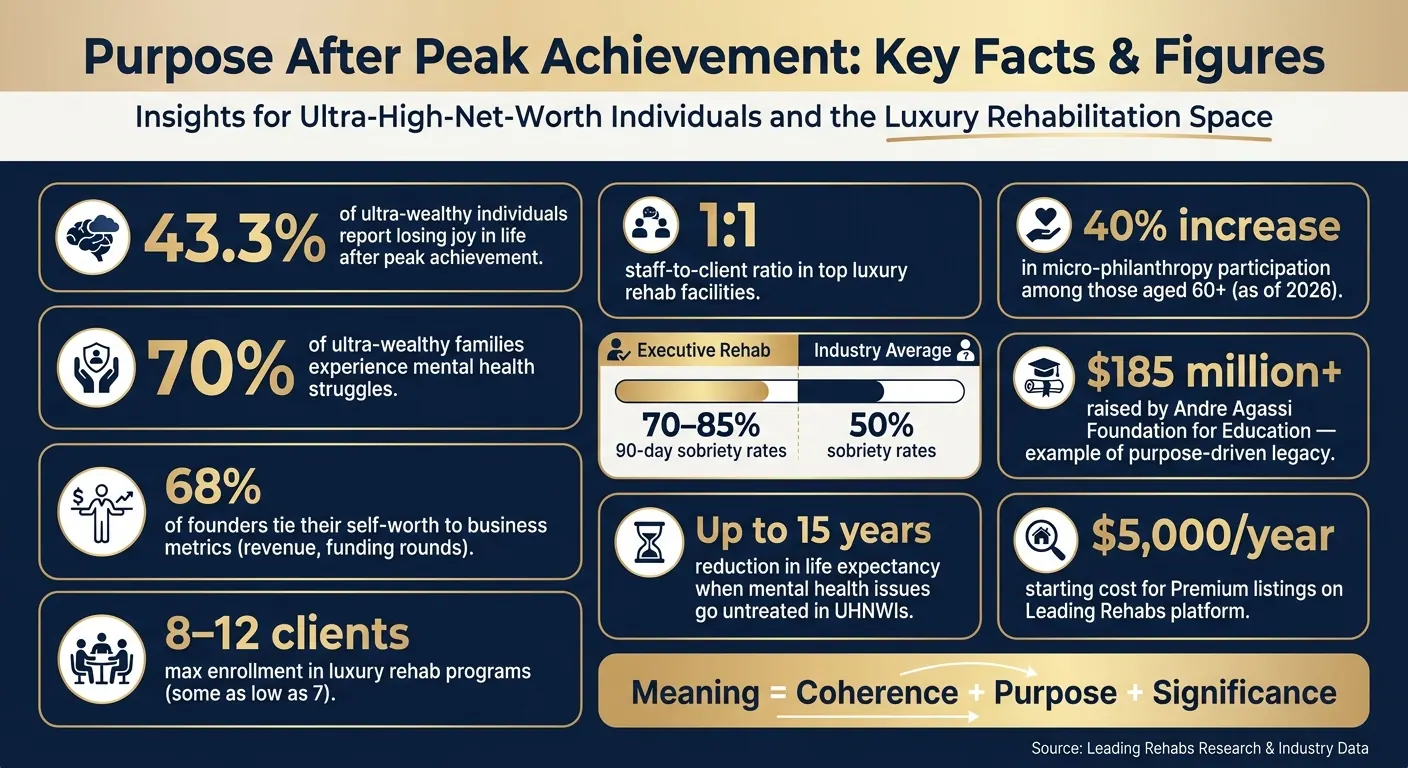
Ultra-Wealthy Mental Health & Luxury Rehab: Key Stats at a Glance
237 ‒ Optimizing life for maximum fulfillment | Bill Perkins
sbb-itb-4b13a7c
Key Emotional and Psychological Challenges After Extreme Success
The emotional aftermath of reaching extraordinary success is often more nuanced than people imagine. Instead of dramatic breakdowns, many ultra-high-net-worth individuals (UHNWIs) experience a quieter struggle - feelings of restlessness or numbness that suggest an inner void, even when they've achieved every external milestone. Let’s take a closer look at how identity struggles, strained relationships, and stigma can deepen this internal discontent.
Identity Loss and Success Addiction
For many UHNWIs, their identity becomes deeply tied to their drive for achievement. What stands out here is how relentless ambition can turn into an addiction, leading to what some researchers describe as "success fatigue". Without the constant pressure of high-stakes challenges, the nervous system often alternates between emotional numbness and persistent anxiety. This disconnect between outward success and inner identity creates a sense of disorientation, leaving individuals unsure of who they are beyond their accomplishments.
Relationship Challenges Tied to Wealth
Wealth has a profound impact on personal relationships. It can breed distrust, as it’s often hard to tell whether people value the individual or their resources. Expansive estates, while luxurious, can unintentionally isolate family members, replacing spontaneous connections with scheduled interactions. This dynamic can erode emotional intimacy, especially in romantic relationships, where couples may focus more on maintaining a polished public image than addressing deeper issues.
Mel Schwartz, L.C.S.W., a psychotherapist and marriage counselor, aptly notes:
"The larger the home, the greater the distance between family members."
Children in affluent households can also face unique struggles - identity confusion, isolation from peers, and the pressure of high expectations. These challenges can undermine their confidence and sense of purpose, further straining family dynamics. Such relational difficulties often reinforce the stigma that prevents many UHNWIs from seeking timely mental health support.
Stigma and Delayed Help-Seeking
In addition to identity and relationship issues, stigma plays a major role in delaying intervention. The common belief that wealth solves all problems makes it difficult for UHNWIs to admit to emotional struggles. Without the everyday pressures of job loss or financial insecurity, early signs of mental health challenges may go unnoticed. This can allow conditions like depression, burnout, or substance abuse to worsen, with some of these issues potentially cutting life expectancy by up to 15 years.
Despite being surrounded by people, many UHNWIs feel profoundly isolated in their internal battles. Addressing these interconnected challenges is crucial for engaging with recovery programs that can help restore a sense of purpose and well-being.
How Luxury Rehabilitation Helps UHNWIs Rediscover Purpose
Challenges like identity loss, strained relationships, and stigma don’t resolve themselves. For ultra-high-net-worth individuals (UHNWIs), luxury rehabilitation programs offer a tailored and structured way to address these issues while considering the unique pressures they face.
What Luxury Rehabilitation Programs Offer
Luxury rehab programs prioritize personalized care. Enrollment is often capped at 8 to 12 clients, and staff-to-client ratios can be as low as 1:1, allowing clinicians to deeply understand each client’s history and goals. Some facilities, like Prospect Hill Wellness, further limit capacity to just seven clients, creating a calm and restorative environment.
Treatment teams are made up of highly qualified professionals, including PhD-level psychologists, board-certified psychiatrists, and executive coaches. These experts are trained to identify and address patterns often overlooked in standard programs, such as functional alcoholism, high-functioning anxiety, and burnout.
For UHNWIs, a major benefit is that these programs often allow clients to stay connected to their work responsibilities. Structured and supervised access to phones and laptops ensures they can fulfill fiduciary duties without compromising recovery. This balance helps clients address deeper emotional and identity-related challenges while maintaining their professional obligations.
"Luxury rehab for executives is not about extravagance. It is about high-quality care, privacy, and programming that aligns with professional responsibilities." - Refresh Recovery & Wellness Centers
How Luxury Rehabs Address Identity and Emotional Challenges
Luxury rehabilitation programs go beyond treating symptoms - they address the underlying psychology tied to high achievement. Therapy often focuses on what researchers call an "achievement-wrapped identity", where self-worth is entirely tied to professional success. Workshops and modules help clients reconnect with their authentic selves, allowing them to separate their identity from their accomplishments.
These programs also treat co-occurring issues like depression, anxiety, and imposter syndrome. The outcomes speak for themselves: executive-focused programs report 90-day sobriety rates of 70% to 85%, significantly higher than the industry average of 50%.
"High achievement can mask deterioration for a long time... The same logic that helps them run complex organizations can trap them in short-term damage control." - Oceans Luxury Rehab
Why Private, Luxury Settings Matter in Treatment
The setting of a rehabilitation program is a crucial part of the healing process. Many luxury centers are intentionally located in serene, low-stimulation environments, such as St. Croix, Marbella, or Palm Beach. These locations help calm overactive nervous systems. Features like private suites, secluded grounds, and strict non-disclosure agreements (NDAs) ensure that clients can seek help without fear of exposure or public scrutiny.
Some programs go even further to guarantee privacy. For instance, Paracelsus Recovery in Switzerland meets clients at the tarmac and guides them through private immigration channels to minimize stress.
"This is our best attempt to recreate the minimum expectation of normality for our clients, to take out as many stressors as possible from the everyday experience." - Jan Gerber, Founder and CEO of Paracelsus Recovery
Recovery in these settings is framed not as a retreat from ambition, but as a way to sustain it over the long term:
"Recovery is not viewed as stepping away from ambition, but as a way to sustain it over the long term." - THE BALANCE Rehab Clinic
Next, we’ll explore how customized therapeutic approaches further empower UHNWIs to reclaim their identity and sense of purpose.
Therapy Approaches That Help UHNWIs Find Meaning
Luxury rehab programs use a blend of evidence-based methods to address the unique and complex psychological needs of ultra-high-net-worth individuals (UHNWIs).
Therapy Frameworks for Meaning and Purpose
The most impactful therapies for UHNWIs go beyond simply managing symptoms. Acceptance and Commitment Therapy (ACT) encourages individuals to clarify their core values and develop psychological flexibility. It challenges them to ask questions like, "What truly matters to you beyond your wealth or title?". Alongside ACT, existential analysis and psychodynamic psychotherapy explore deeper questions of authenticity and purpose.
For those who have relied on external success to mask inner struggles, trauma-informed care helps uncover and address the fears and shame that wealth can hide but not resolve. The Health-Wealth Paradox Framework is another key tool, tackling the psychological challenges tied to wealth, such as identity crises and feelings of alienation, to help clinicians guide clients through these intricate issues.
"If you weren't CEO, who would you be? If you failed in the next deal, what would you still stand for?" - Dr. Jerry Don Smith Jr., Clinical Psychologist
A strategy called "role-portfolio re-authorization" helps leaders expand their identity beyond professional titles. By exploring roles like mentor, family steward, or philanthropist, individuals can redefine their sense of self and purpose. These approaches naturally pave the way for practices that center attention and presence in the here and now.
Mindfulness and Contemplative Practices
Mindfulness techniques - such as breathwork, yoga, and meditation - play a key role in calming the nervous system and reducing chronic stress.
Luxury programs often include practices like Transcendental Meditation (offering a detached perspective), Vipassana (fostering inner awareness), and Zen Buddhism (promoting focus and simplicity). These techniques act as mental training, helping individuals observe their thoughts without becoming controlled by them.
"Tuning into the present moment is one of the best tools we have for changing that 'I want more' into an 'I am enough' mindset." - Paracelsus Recovery
Ray Dalio, founder of Bridgewater Associates, has shared that meditation has significantly boosted his productivity by enhancing openness, calmness, and creativity. For UHNWIs in recovery, this clarity of mind is a stepping stone to rediscovering what truly matters. This mindful awareness also prepares clients for broader lifestyle interventions.
Lifestyle Medicine and Neuroscience-Based Interventions
Luxury rehab programs often combine personalized approaches to nutrition, sleep optimization, and fitness with advanced techniques like neurofeedback and biofeedback to help recalibrate the brain's stress response.
"Neurofeedback and biofeedback sessions... help retrain the brain's stress response, which is often in overdrive for high performers." - Maryann Rosenthal, PhD, CEO, Alta Mira Recovery
Comprehensive neuropsychological testing, often conducted over several days, can reveal hidden conditions like undiagnosed ADHD or trauma that might be obscured by professional achievements. Additionally, biochemical restoration targets nutritional deficiencies and chemical imbalances that aggravate burnout or depression, helping to rebuild mental and physical health at its core. By aligning physical well-being with neurological health, clients are better equipped to reconnect with their values and priorities.
Practical Steps for Rebuilding Purpose
When it comes to reclaiming identity and purpose, UHNWIs can benefit from these intentional practices, which build on tailored therapies to promote meaningful change.
Guided Identity Reconstruction
One of the first steps is separating your identity from your achievements. Studies reveal that 68% of founders tie their sense of self to business metrics like revenue or funding rounds. When those numbers plateau, it’s no surprise their self-worth takes a hit.
A helpful tool for this is creating a role-map. This structured document breaks your identity into different roles - such as founder, family member, mentor, or citizen-philanthropist - showing that you’re not defined by just one aspect of your life. Pair this with a "Shadow Board of Self", a trusted group of psychologists, coaches, and peers who ask tough, existential questions. This creates accountability and helps shift your perspective. From here, you can explore outward expressions of meaning, like strategic philanthropy or reflective retreats.
"The open field is not a problem. It's where your next purpose begins." - Becky Henderson, Self-Mastery Coach, The Plenteous Life
Another simple yet effective method is a weekly 15-minute Purpose Audit over four weeks. It involves answering three questions: What feels complete? What still feels alive? And what are you willing to be a beginner at again? This practice helps pinpoint where your energy is naturally flowing.
Philanthropy and Impact Investing as Purpose-Driven Tools
Strategic giving can be a powerful way to rebuild meaning. The shift here is moving from financial ROI to "Personal ROI", which prioritizes emotional energy and personal fulfillment over monetary returns.
Start by crafting a philanthropic mission statement. This short document clarifies the why behind your giving, transforming donations from transactional to deeply personal. As Dave Alison, CFP® at Alison Wealth Management, explains:
"When the return you're seeking is personal fulfillment, passion is the compass."
Micro-philanthropy, or "guerrilla philanthropy", is another impactful approach. This involves small, direct acts of giving, such as anonymous donations or local volunteering. It’s especially popular among those aged 60 and older, with participation up 40% as of 2026. These quiet, tangible contributions reconnect individuals with a version of themselves that isn’t tied to status or scale. A notable example is Andre Agassi, who, after retiring from tennis in 2006, focused on his Andre Agassi Foundation for Education. The foundation has since raised over $185 million and opened more than 130 charter schools. This new mission gave him purpose beyond his athletic achievements.
In addition to giving, immersive experiences and legacy planning can further solidify an identity no longer tied to past metrics of success.
High-End Retreats and Legacy Planning
For those stuck in what researchers call the "performance without presence" cycle - where achievements feel hollow - structured retreats can provide a much-needed reset. These retreats help recalibrate the nervous system, shifting you out of high-stress "survival mode" into a state that encourages reflection and creativity.
"Success without fulfillment often creates a subtle but constant pressure... like carrying an invisible weight that never truly lifts." - Victor Alekseev, Founder, LifeRetreat
Legacy planning also takes on a deeper meaning here, going beyond managing estates. Many programs guide participants in creating a "Meaning Manifesto" - a personal statement about how they want to live and what they hope to leave behind. This is often shared aloud in a supportive community. As Arthur Brooks explains, meaning can be broken down into a simple formula: Meaning = Coherence + Purpose + Significance. Retreats built around this framework help identify which of these elements feels lacking and provide tools to address it.
Using Leading Rehabs to Find the Right Treatment

Choosing the right treatment center for high-profile individuals isn’t just about finding a reputable facility - it’s about identifying one that truly understands the unique pressures tied to immense success. For ultra-high-net-worth individuals (UHNWIs) grappling with challenges after achieving significant milestones, this level of specialized care is essential. Privacy, discretion, and a tailored approach are key to helping these individuals rediscover purpose.
How Leading Rehabs Profiles Treatment Centers
Established in 2023, Leading Rehabs is a platform designed to connect UHNWIs with treatment centers that cater specifically to their needs. Instead of generic reviews, the platform focuses on centers that address what they call the "Executive's Dilemma." This term refers to the hidden struggles high achievers face, where outward success often masks internal challenges, and conventional treatments fail to meet their needs.
Each treatment center profile on the platform includes detailed information about therapies, conditions treated, and program structures. For example, many centers offer Dual Diagnosis treatments tailored to executives, addressing issues like imposter syndrome, high-functioning anxiety, and burnout driven by success. Users can also search for facilities that prioritize small, exclusive client groups to ensure privacy and limit interactions with professional peers.
Evaluating Confidentiality and Expertise Through Leading Rehabs
For UHNWIs, confidentiality isn’t just a preference - it’s critical. Anthony Saracino of Safe Haven Behavioral Health highlights the stakes:
"For a public figure, a CEO, or a high-net-worth family, a breach of privacy isn't just embarrassing; it can trigger a drop in stock prices, the loss of a medical license, or a media scandal."
Leading Rehabs helps users assess confidentiality standards through features like verified badges, including LegitScript certification, and on-site reviews. Profiles detail whether centers implement measures such as legally binding NDAs for staff, encrypted communication channels, and decoy billing practices to keep treatment off insurance records and financial statements.
On the clinical side, the platform provides transparency into staffing credentials, ensuring that top-tier executive programs employ highly qualified professionals with proven track records. These rigorous privacy protocols and credential verifications ensure treatment centers can effectively serve UHNW clients without compromising their security or reputation.
How Treatment Centers Can Use Leading Rehabs to Reach UHNW Clients
Leading Rehabs also offers treatment centers tools to connect with UHNW clients. Simply having a polished website isn’t enough to reach this demographic. The platform provides Premium listings, starting at $5,000 per year, enabling facilities to showcase their full range of services. These profiles highlight offerings like identity reconstruction therapies, structured support for fiduciary responsibilities, and advanced privacy measures. Additional features such as on-site reviews, video tours, and podcasts give prospective clients a transparent view of the center’s approach.
Moreover, these profiles address "treatment fatigue" by promoting a continuum of care. This ensures clients can move seamlessly from detoxification to virtual intensive outpatient programs without needing to repeat their story to multiple providers.
As Noah Nordheimer, CEO of All Points North, puts it:
"We look at people as individuals and come up with treatment plans that are tailored to them. We don't put people into cookie-cutter 'programs.' We design programs around people."
Conclusion: Finding Meaning Beyond Achievement
Reaching the pinnacle of success often brings an unexpected inner battle. For many ultra-high-net-worth individuals, the emotional struggles we've explored here can have serious health repercussions - making this issue far more than just a philosophical dilemma.
Moving forward calls for a shift in perspective: from chasing accomplishments to seeking meaningful contributions. As Dr. Ronit Lami, Wealth Psychologist, explains:
"Freedom isn't the absence of work. It's the presence of meaning."
This highlights the importance of structured, professional intervention to foster lasting change. Rediscovering purpose involves a multi-faceted approach, including identity rebuilding, mindfulness, legacy planning, and tailored clinical care. Luxury rehabilitation programs offer the privacy, expertise, and peer network needed to help high-profile individuals redefine their lives without jeopardizing their reputation or careers.
"Legacy is not ultimately measured by what you accumulate. It is measured by what continues meaningfully because you existed."
Leading Rehabs simplifies the process of connecting UHNWIs with the specialized support they need. By bridging the gap between recognizing the need for help and accessing it, the platform ensures a smoother path to regaining purpose and creating a lasting impact.
FAQs
How do I know if I’m experiencing the arrival fallacy?
If you’ve ever felt empty, disappointed, or unfulfilled after achieving a big goal, you might be dealing with the arrival fallacy. Instead of the lasting happiness you expected, you’re left feeling let down or even lost. Common signs include feeling adrift once you’ve hit a milestone or rushing to set new goals just to fill the void. This often happens when your goals are shaped by what others expect of you, rather than what truly matters to you.
What should I look for in a private luxury rehab program?
When selecting a private luxury rehab, it's important to focus on facilities that uphold top-tier clinical standards and ensure absolute discretion. Key features to look for include a low client-to-staff ratio - ideally between 1:1 and 1:3 - and round-the-clock on-site medical care. Having doctorate-level clinicians who provide personalized, evidence-based treatment is another crucial factor.
A high-quality facility should also address specific challenges, such as burnout or perfectionism, and offer tailored executive support, like controlled work access, to meet professional needs. Strict privacy measures are non-negotiable, ensuring confidentiality throughout the process. Finally, robust aftercare planning is vital to support long-term recovery and maintain progress after treatment.
How can I rebuild purpose without losing my drive to achieve?
Rebuilding your sense of purpose while staying motivated often involves turning your attention inward, focusing less on external achievements and more on personal fulfillment. Success doesn't have to be the finish line - it can become a stepping stone for making a meaningful impact.
Here are some ways to approach this:
- Redefine your purpose by engaging in activities like mentorship or acts of service. Helping others can bring a renewed sense of meaning to your efforts.
- Experiment with low-pressure projects or volunteer work to discover what sparks your energy and enthusiasm. These experiences might reveal new passions or directions.
- Incorporate mindfulness or meditation into your routine to clear your mind and reconnect with what truly matters to you. These practices can help you regain focus and perspective.