
The Loneliness of Being Untouchable: Mental Health Support for the Ultra-Elite

The ultra-wealthy face a unique paradox: immense wealth and influence often lead to profound isolation. Despite being surrounded by advisors and staff, many high-profile individuals struggle with loneliness, trust issues, and the pressure to maintain a flawless public image. This emotional distance, compounded by fears of exploitation and reputational risks, creates significant mental health challenges.
Key takeaways:
- 50% of CEOs report feeling isolated, with 61% believing it affects their performance.
- Isolation stems from security measures, public scrutiny, and transactional relationships.
- Mental health issues like depression, anxiety, and burnout often manifest differently in this group.
- Stigma and fear of vulnerability delay help-seeking; 80% avoid mental health services.
Solutions include:
- Concierge psychiatry: Private, 24/7 mental health care tailored to high-profile individuals.
- Luxury rehab programs: One-on-one care in ultra-private settings.
- Exclusive retreats: Short-term programs for emotional recovery and stress management.
- Long-term strategies focus on building trusted relationships, improving family dynamics, and finding purpose beyond professional success.
Mental health care for the ultra-elite isn’t indulgent - it’s a necessity for sustaining leadership and personal well-being.
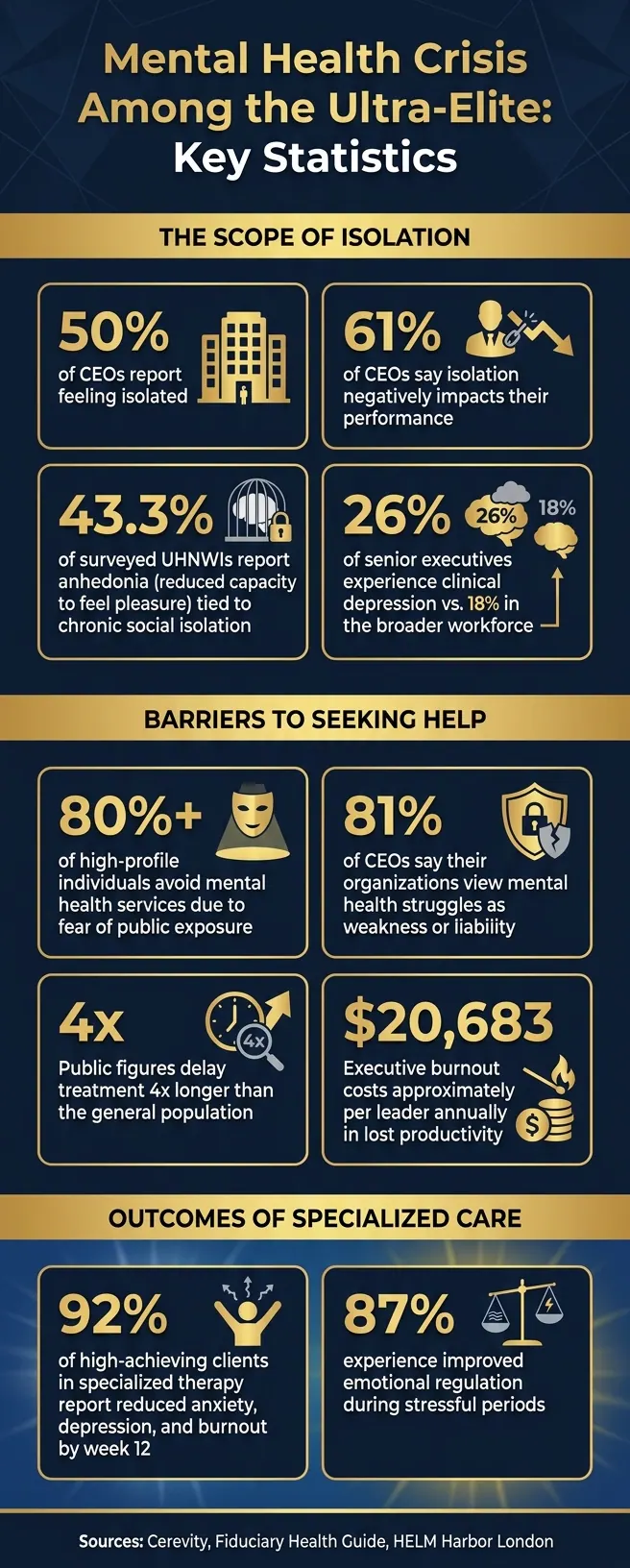
Mental Health Crisis Among the Ultra-Elite: Key Statistics
Behind Closed Doors: Mental Health Among the Ultra Wealthy [RTL Explosiv - Klinik für Superreiche]
sbb-itb-4b13a7c
Understanding the Isolation of the Ultra-Elite
For ultra-high-net-worth individuals (UHNWIs), isolation isn’t just a feeling - it’s a built-in part of their daily lives. The wealth and influence that grant them unparalleled freedom also create invisible walls, separating them from broader society. Let’s break down how these barriers shape their interactions and emotional well-being.
What Ultra-Elite Isolation Actually Looks Like
At first glance, the ultra-wealthy seem anything but isolated. Their schedules are packed with exclusive events, meetings, and a network of advisors. Yet, despite this constant activity, authentic connections are rare. Layers of security, gated mansions, and strict legal measures ensure privacy but also make spontaneous, meaningful relationships nearly impossible.
A recurring challenge for UHNWIs is the nagging question: “What do they want from me?” Dr. Trevor Grossman, a Licensed Clinical Psychologist at Cerevity, explains:
"When your net worth separates you from most of society, authentic connection becomes difficult. Others may see you as an opportunity rather than a person."
This phenomenon, sometimes referred to as Wealth Isolation Syndrome, fosters a deep sense of loneliness. Even in social settings, the ultra-elite often feel more like targets than participants. Research highlights this troubling reality, showing that society increasingly views the wealthy as resources rather than individuals. These dynamics contribute significantly to the mental health struggles many UHNWIs face.
This guarded way of living creates a sharp divide between their public and private selves, which leads us to the next challenge.
The Visibility-Invisibility Paradox
UHNWIs live a life of extremes when it comes to visibility. On one hand, they’re under constant public scrutiny. On the other, their emotional lives remain hidden behind a carefully curated image. They’re expected to project confidence and control at all times, as any sign of vulnerability can be seen as weakness - or worse, a liability.
Dr. Lami, a psychologist specializing in wealth-related issues, puts it this way:
"Many of my clients describe it as 'being surrounded, but unseen.'"
This dual existence takes a toll. Publicly, they appear polished and composed, but privately, they may struggle with exhaustion, anxiety, or feelings of emptiness. Over time, the effort to maintain this emotional double life can lead to serious consequences. In fact, 43.3% of surveyed UHNWIs reported experiencing anhedonia - a reduced capacity to feel pleasure - often tied to chronic social isolation. This emotional strain not only impacts their mental health but also leaves them vulnerable to legal and relational challenges.
Emotional and Legal Untouchability
For UHNWIs, showing vulnerability can come with real risks. A medical diagnosis, for instance, could be weaponized in lawsuits, corporate board decisions, or even custody battles. This creates a culture of mistrust, where even family and close associates may be viewed with suspicion.
Legal and financial safeguards, like family offices and non-disclosure agreements (NDAs), are designed to protect UHNWIs. However, these measures often make relationships feel transactional rather than genuine. Over time, these structures only deepen the emotional distance.
Several factors amplify this disconnect:
| Factor | How It Creates Distance |
|---|---|
| Security & Privacy Protocols | Gated estates, private entrances, and security teams limit casual, everyday interactions |
| NDAs & Legal Structures | Conversations and relationships are often formalized, reducing emotional openness |
| Public Persona Management | The effort to maintain a polished public image adds to emotional exhaustion |
| Trust Erosion | Experiences with exploitation and litigation make it hard to trust others' intentions |
| Decision Fatigue | Managing global businesses and family offices creates a cognitive burden that isolates them from ordinary concerns |
Each of these factors builds on the others, creating a life where emotional isolation becomes the norm. The ultra-elite may have unparalleled resources, but these very tools often reinforce the barriers that keep them disconnected from genuine human connection.
Mental Health Risks Specific to the Ultra-Elite
The mental health challenges faced by the ultra-elite are not just shaped by their isolation but also take on unique forms that are deeply tied to their lifestyles and responsibilities.
Common Mental Health Conditions in This Group
Mental health issues among the ultra-elite often present differently compared to the general population. For instance, clinical depression affects about 26% of senior executives, a notable contrast to 18% in the broader workforce. However, depression in this group rarely manifests as classic sadness. Instead, it shows up as irritability, feelings of emptiness, or a lack of purpose.
Anxiety, too, takes on a distinct form. Rather than stemming from everyday worries, it is often tied to wealth-specific fears such as kidnapping or reputational damage. Substance use is another notable concern. Many in this group rely on stimulants to maintain high performance during the day and turn to alcohol or sedatives to unwind at night. This pattern can delay the visible signs of substance-related problems, making them harder to detect compared to the general population.
"The individual who 'has everything' and yet cannot find motivation is perceived as ungrateful, lazy, or morally deficient rather than clinically depressed." - Fiduciary Health Guide
These unique presentations of mental health conditions highlight the need for specialized approaches to diagnosis and care.
Stressors That Are Specific to the Ultra-Elite
The ultra-elite face stressors that are deeply tied to their roles and the immense responsibilities they carry. One significant factor is identity fusion, where a founder or CEO’s sense of self becomes inseparable from their organization. In such cases, a business setback isn’t just a professional challenge - it feels like a personal failure. Events like selling a company (liquidity events) can also act as major mental health triggers.
For those who inherit wealth, intergenerational pressure adds another layer of stress. These individuals often feel a need to justify their privilege through exceptional achievements, which can lead to anxiety and depression within affluent families.
Another key stressor is the burden of fiduciary responsibility. Executives must make decisions that impact vast amounts of capital and thousands of employees, creating a chronic stress response that doesn’t end when the workday does. This constant pressure contributes to executive burnout, which is estimated to cost around $20,683 per leader annually due to lost productivity.
These stressors, deeply rooted in their unique circumstances, further amplify the challenges already posed by their isolation and high-stakes roles.
Stigma and Delayed Help-Seeking
Stigma is a significant barrier preventing the ultra-elite from seeking mental health support. Studies show that over 80% of high-profile individuals avoid mental health services due to fears of public exposure. On average, public figures delay treatment four times longer than the general population.
The stakes for seeking help are particularly high for this group. A psychiatric diagnosis could be weaponized in legal battles, such as divorce proceedings, or used to invoke "incapacity" clauses in trust agreements. It can also quietly erode confidence among board members. In fact, 81% of CEOs report that their organizations view mental health struggles as a sign of weakness or liability.
"The same resilience and determination that enabled the executive to reach this position often prevents them from acknowledging needing support. Asking for help can feel like admitting failure, even when it represents wisdom." - Martha Fernandez, LCSW, Co-Founder of CEREVITY
The paradox is clear: the very traits that drive these individuals to succeed - self-reliance, calm under pressure, and relentless performance - often make it incredibly difficult for them to admit they need help. This creates a cycle where stigma and the fear of vulnerability keep them from accessing the support they urgently need.
Mental Health Support Options Designed for the Ultra-Elite
Traditional mental health services often fall short for the ultra-elite. This group demands absolute privacy, immediate access, and solutions that align with their demanding schedules. Here’s a look at specialized programs tailored to meet these unique needs.
Concierge Psychiatry and Private Therapy
Concierge psychiatry removes many of the barriers that prevent high-profile individuals from seeking help. Forget waiting lists, intake forms, or any information filtering into a client’s professional circle. As one provider states: "Nothing enters the organisation. Ever."
In this model, clients are paired with a dedicated consultant psychiatrist supported by a multidisciplinary team, which can include therapists, physicians, and nutritionists, all available 24/7. These teams, sometimes comprising up to 15 experts, provide care wherever the client needs it - be it at home, in a private villa, or while traveling. Admission is highly selective, focusing on individuals earning over $1.5 million annually, with "irreplaceability" being the key criterion.
"We are not trying to reach more people. We are trying to make sure the very small number of people we do reach receive something no broader service could meaningfully provide." - Helm · Harbor London
This approach combines biochemical restoration - targeting nutritional and physiological imbalances that affect mood and cognition - with traditional psychotherapy. It’s designed to ensure continuous care while minimizing risks to both reputation and legal standing. For clients needing more intensive support, luxury residential programs provide an even higher level of privacy and care.
Luxury Residential Rehabilitation Programs
When more structured care is necessary, luxury residential programs offer unparalleled privacy and clinical depth. Facilities like The Balance Rehab Clinic - with locations in Mallorca, Zurich, London, and Marbella - and Privé-Swiss, which boasts over 25 years of experience in ultra-private care, use a single-client model. This means one client, one dedicated team, and no interaction with peers.
"Environment influences regulation, sleep, and engagement in treatment... Hospitality exists to remove stressors and protect privacy - not to distract from treatment." - THE BALANCE Rehab Clinic
Treatment plans are fully customized based on the client’s history, professional demands, and clinical needs. For example, Prospect Hill Wellness limits its capacity to just seven clients at a time, while executive programs at Headwaters last 30 to 45 days, depending on clinical assessments. Admissions are handled discreetly, with private travel arrangements ensuring complete confidentiality. Costs for this level of care start at $16,200 per week.
| Feature | Traditional Luxury Rehab | Ultra-Elite Single-Client Rehab |
|---|---|---|
| Client Capacity | 10–30+ patients | 1 patient at a time |
| Privacy Level | Shared common areas; peer groups | Private villa; no peer interaction |
| Connectivity | Often restricted or prohibited | Structured access to laptops/phones |
| Clinical Focus | Group-based therapy | 1-on-1 intensive psychotherapy & neurobiology |
| Staff-to-Client Ratio | Moderate (e.g., 1:3 or 1:5) | Entire team dedicated to one client |
Exclusive Wellness Retreats
For those who aren’t in crisis but feel emotionally drained by constant pressure, short-term intensive retreats offer a middle ground between regular therapy and full residential care.
These retreats are often located far from the client’s professional world - places like Mauritius, Costa Rica, or the Caribbean - deliberately chosen to ensure anonymity.
"Distance is the most underrated form of privacy. Treatment inside your home jurisdiction means your treatment lives inside your jurisdiction too." - Les Mariannes
Programs like Les Mariannes in Mauritius boast a 94% success rate over 25 years. Meanwhile, Ruhani's Elite Immersion offers a 9-week protocol, including 4 weeks of remote preparation followed by 4 weeks of guided integration, priced at $20,000. Privé-Swiss provides up to 65 one-on-one therapy sessions per month, led by clinicians with at least 20 years of experience.
Staff at these retreats operate under strict NDAs, and clients can be admitted under pseudonyms for added discretion. Encrypted workspaces allow for scheduled "business windows" so clients can stay on top of essential responsibilities. Care goes beyond mental health, incorporating precision medicine, biomarker-guided nutrition, and sleep optimization to address the full impact of high-pressure lifestyles.
How the Ultra-Elite Can Rebuild Connection and Emotional Safety
Specialized programs and retreats might stabilize a crisis, but long-term emotional well-being depends on actively restoring authentic human connections. After examining the challenges of isolation, let’s turn to practical ways to rebuild trust and connection. This process focuses on three key areas: assembling a mental health team, strengthening family and inner-circle relationships, and finding purpose beyond professional success.
Building a Trusted Mental Health Team
For those navigating high-pressure careers, one therapist often isn’t enough. Experts suggest forming a multidisciplinary team that includes a doctorate-level psychiatrist, psychologists, somatic therapists, an executive coach, and an integrative medicine specialist. Confidentiality is critical - team members should sign strict nondisclosure agreements, and billing should be handled privately.
This approach has shown impressive results: 92% of high-achieving clients in specialized therapy report reduced anxiety, depression, and burnout symptoms by the 12th week, while 87% experience improved emotional regulation during stressful times. A strong clinical team creates the foundation for addressing deeper relational issues.
Repairing Family and Inner-Circle Dynamics
Extreme wealth often complicates relationships. Siblings may clash over inheritance, children can struggle with identity, and spouses might feel overshadowed by a partner’s public persona. Family systems therapy directly addresses these issues. One effective method is the "moving-in/moving-out" approach. Therapists first immerse themselves in each family member’s experience before stepping back to address the family as a whole.
The goal is to create psychological safety, a concept defined by Harvard Business School professor Amy Edmonson as:
"Psychological safety is a shared belief held by members of a team that the team is safe for interpersonal risk taking."
To repair family dynamics, families can follow four steps: assess current relationships, create a structured plan with measurable goals, practice healthier interactions in a safe environment like a private retreat, and schedule regular check-ins to maintain progress. Once the inner circle is strengthened, individuals can focus on rediscovering purpose and forming connections beyond their wealth.
Finding Purpose and Building Meaningful Relationships
For many ultra-high-net-worth individuals, personal identity becomes deeply tied to professional success. Major transitions, like selling a business or retiring, can lead to feelings of emptiness. Trevor Grossman, PhD, Licensed Clinical Psychologist, explains:
"When you've accomplished what most consider impossible, the question 'What's next?' can create existential emptiness. Many high achievers struggle with meaning and purpose after reaching traditional markers of success."
Engaging in purpose-driven activities can help. Participating emotionally in philanthropic efforts - not just financially - can foster genuine connections and counter feelings of emptiness. For example, a 2024 case study by Drayson Mews described a UHNW family whose son, Andre, faced severe depression and isolation. By involving him in the family’s Zurich-based foundation, they shifted from conflict to a shared sense of purpose, guided by a year-long clinical plan focused on psychological safety.
Peer groups of other ultra-high-net-worth individuals also offer a space to build relationships based on shared goals rather than wealth. As Dr. Lami, Wealth Psychologist, notes:
"It's not that there's a lack of people, it's that there's a lack of safety."
Rebuilding this sense of safety - through clinical support, stronger personal relationships, and a renewed sense of purpose - is the next step after any retreat or program.
Conclusion: Why Mental Health Must Be a Priority for the Ultra-Elite
The realities we’ve explored underscore a critical truth: mental health cannot be sidelined, even for the ultra-elite. The numbers paint a stark picture - 50% of CEOs feel isolated, and 61% admit that this isolation negatively impacts their performance. Despite this, many leaders hesitate to seek help, driven by societal expectations to project unwavering strength. As Martha Fernandez, LCSW, Co-Founder of CEREVITY, aptly states:
"The strongest leaders are the ones who recognize when they need support and act on it."
Ignoring mental health concerns doesn't just affect the individual - it disrupts decision-making, strains leadership, and sends shockwaves through organizations and families. Burnout alone costs companies $20,683 per executive annually in lost productivity. Addressing these issues early can mitigate both personal and organizational fallout.
Fortunately, there are effective and discreet solutions. From concierge psychiatry to exclusive wellness retreats, these options are designed to meet the ultra-elite’s need for privacy and address their unique challenges. These tailored approaches prove that mental health care for high-level leaders is not only feasible but essential.
Trevor Grossman, PhD, Licensed Clinical Psychologist, sums it up perfectly:
"The most successful people I work with share one quality: they understand that optimizing mental health isn't self-indulgence - it's strategic investment."
Proactively seeking support before hitting a breaking point is what sets enduring leaders apart. This isn’t about pulling back from ambition; it’s about building the resilience to sustain it. By prioritizing expert, confidential mental health care, the ultra-elite can achieve not just professional longevity but also personal well-being.
FAQs
How can someone stay in therapy without it showing up in legal or business records?
To maintain therapy entirely off legal or business records, consider using private-pay mental health services instead of relying on insurance. When therapy involves insurance, it generates records such as diagnosis codes and Explanation of Benefits (EOB) statements, which could potentially be accessed by third parties. Look for providers who prioritize privacy by implementing strict confidentiality protocols, using encrypted communication methods, and limiting staff access to sensitive information. These steps can help ensure your treatment stays confidential and discreet.
What are the warning signs of burnout or depression in high-performing leaders?
Burnout and depression in leaders with demanding roles can manifest in several ways, affecting their mental, emotional, and physical well-being. Cognitive indicators might include difficulty concentrating, diminished problem-solving abilities, and slower decision-making. Emotional changes often appear as increased irritability, feelings of cynicism, or a sense of hopelessness. On the physical side, chronic exhaustion, trouble sleeping, or unexplained aches and pains are frequent red flags. Additionally, shifts in behavior - like pulling away from social interactions or leaning more heavily on alcohol or medications - can also point to underlying struggles.
How do you choose between concierge psychiatry, a private rehab stay, or a retreat?
Choosing the right care option comes down to your specific clinical needs, your desire for privacy, and how much you value personalized attention.
- Concierge psychiatry works well if you’re looking for high-level psychiatric support while managing your daily responsibilities.
- Private rehab is a better fit if you need structured, residential care, constant supervision, or a safe place for detox.
- Exclusive retreats are the go-to choice if complete privacy is your top priority, as they often provide individualized care without a set location or shared spaces.
Focus on finding a program that aligns with your schedule, professional commitments, and personal treatment goals.