
Insomnia & Sleep Disorders in Busy UHNWIs: Root-Cause Treatment

Sleep problems among ultra-high-net-worth individuals (UHNWIs) often stem from demanding lifestyles that disrupt natural rhythms. Chronic jet lag, late-night work stress, and high-pressure decision-making create a perfect storm for insomnia. Standard advice like avoiding caffeine or maintaining a routine often fails because these issues are deeply tied to biological and psychological factors.
Key insights:
- Lifestyle stressors: Constant travel, irregular schedules, and late-night work elevate cortisol levels, disrupting sleep.
- Health impacts: Sleep deprivation harms judgment, memory, and even long-term health, increasing risks for cardiovascular disease and inflammation.
- Root causes: Issues like HPA axis dysregulation, sleep apnea, and psychological stress require targeted solutions.
- Tailored treatments: Options include advanced diagnostics, CBT-I therapy, orexin antagonists, and luxury rehabilitation programs.
For UHNWIs, solving sleep issues means addressing the underlying causes through precise, personalized care rather than relying on generic fixes.
SLEEP: Root causes of Insomnia and 17 Natural Sleep Tips
sbb-itb-4b13a7c
Why UHNWIs Struggle with Sleep
The sleep challenges faced by Ultra-High-Net-Worth Individuals (UHNWIs) often stem from a lifestyle that's at odds with the body's natural rhythms. Constant travel, high-pressure decision-making, and a culture of being perpetually "on" make it difficult to achieve the restorative sleep their bodies need.
Lifestyle and Environmental Stressors
Irregular schedules are a hallmark of this lifestyle. Frequent travel across multiple time zones wreaks havoc on the body's internal clock. Eastward travel is particularly tough - our bodies adjust at a rate of about one hour per day, compared to 1.5 hours for westward travel. Imagine flying from New York to Tokyo and back within a week - your circadian rhythm wouldn't have a chance to recover before the next trip begins.
Late-night emails and calls only add to the problem. These activities elevate cortisol levels, which should naturally decline before bedtime. Dr. Natun Verma, a Stanford-trained sleep physician, explains:
"The 'always-on' culture means the nervous system does not care that you have an early flight... If you have answered a tense email at 9:45 p.m., your body is doing exactly what it was designed to do: stay alert."
Even caffeine, a staple for many busy professionals, can disrupt sleep. With a half-life of about 6.5 hours, that noon coffee could still be keeping you wired well into the night.
These disruptions don’t just throw off sleep schedules - they also set the stage for long-term cognitive and health issues.
How Sleep Disorders Affect Health and Cognition
The impact of poor sleep extends far beyond feeling tired. Just one night of only 5–6 hours' sleep can impair judgment, decision-making, and emotional stability. For executives making high-stakes decisions, even a single short night can have noticeable effects on performance.
But the real damage comes from chronic sleep deprivation. Over time, consistent lack of sleep is linked to increased cardiovascular risks, reduced insulin sensitivity, and heightened systemic inflammation. Cognitive abilities also take a hit - working memory, problem-solving, creativity, and even the ability to read social cues can decline. As Matthew Gutierrez puts it:
"The tax is rarely obvious. Many executives believe they have adapted to six hours of sleep... Over time, the performance cost compounds."
These consequences highlight the need for tailored sleep strategies that address the unique demands of UHNWIs. As physical health suffers, psychological stress often intensifies, further disrupting sleep.
Psychological Factors Behind Insomnia
While physical disruptions play a big role, psychological stress can be just as damaging. Many high achievers treat sleep as another metric to optimize, obsessively tracking sleep scores with wearables. This fixation can lead to a condition called orthosomnia, where the pressure to achieve "perfect sleep" creates anxiety, making it even harder to fall asleep.
Dr. Maria Niitepold, PsyD, explains:
"Sleep is not a state you can actively do. It is a state you must surrender to. For the hyper-independent executive, surrender is a terrifying concept."
For individuals whose identities revolve around control and performance, the idea of letting go - an essential part of falling asleep - can trigger an adrenaline response. When combined with underlying anxiety, depression, or identity-related stress, these psychological factors can create a vicious cycle that standard sleep hygiene practices may not fully resolve.
Root Causes of Insomnia in High-Performing Individuals
Insomnia in high-performing individuals often stems from a mix of biological, behavioral, and habitual factors. For ultra-high-net-worth individuals (UHNWIs), these causes rarely fit into a single category, making it essential to understand the layered complexities behind sleep disruption.
Medical and Physiological Causes
One major contributor is HPA axis dysregulation. The constant demands of a high-output lifestyle can keep the hypothalamic-pituitary-adrenal axis in overdrive, leading to elevated cortisol levels late into the evening. Dr. Shiv K. Goel, MD, Founder of Prime Vitality, explains:
"Elevated evening cortisol directly suppresses melatonin production. The pineal gland cannot trigger the sleep cascade when cortisol signaling is still active. The body is stuck in alert mode regardless of how exhausted it feels."
This explains the "tired but wired" feeling that many executives report.
Another significant factor is breathing irregularities, such as obstructive sleep apnea (OSA). This condition, particularly prevalent in high-functioning adults over 40, affects 30% to 40% of OSA patients who also experience insomnia symptoms. For those with COMISA (Comorbid Insomnia and Sleep Apnea), the combination of OSA-triggered micro-arousals and insomnia-related hyperarousal creates a cycle that basic sleep hygiene practices cannot break.
Additionally, a deficient GABA system coupled with an overactive orexin system makes it biologically difficult to quiet the mind, even for individuals with disciplined routines.
Behavioral and Substance-Related Causes
Behavioral choices and substance use also play a critical role in sleep disruption. For instance:
- Alcohol consumption disrupts REM sleep in the first half of the night and fragments sleep in the second half. This means that even if someone spends extra time in bed, they may not achieve the deep, restorative sleep their body needs.
- Late-night eating, often due to business dinners or social obligations, can interfere with sleep. Studies show eating within three hours of bedtime increases the likelihood of middle-of-the-night awakenings by 61%. This is due to digestion raising core body temperature, which disrupts the cooling process necessary for deep sleep.
- Sleep medication misuse is another issue. Many executives rely on sedatives or over-the-counter aids, unaware that around 60% of their perceived effectiveness comes from the placebo response.
These factors highlight the importance of addressing both biological and behavioral components to improve sleep quality.
Why a Full Evaluation Matters
Standard sleep advice - like dimming lights, avoiding caffeine, and maintaining a consistent schedule - often doesn't work for high-performing individuals. As Riley Jarvis, The Sleep Consultant, points out:
"Standard advice fails for chronic insomniacs because it assumes the problem is behavioural or psychological... when the problem is biological, you need biological investigation."
A complete evaluation should consider predisposing factors (such as genetics and neurological baselines), precipitating factors (acute stress or irregular travel), and perpetuating factors (habits that reinforce poor sleep patterns). For UHNWIs, assessments need to go beyond standard physical exams to include both biological and behavioral insights. Tools like the Dried Urine Test for Comprehensive Hormones (DUTCH), which tracks cortisol levels throughout the day, can help identify whether elevated evening cortisol is a key issue. If breathing or movement disorders are suspected, polysomnography can provide a clearer picture.
| Biological Root Cause | Common Symptom | Recommended Investigation |
|---|---|---|
| HPA Axis Dysregulation | "Tired but wired", midnight hyperactivity | 4-point salivary or dried urine cortisol mapping |
| COMISA (OSA + Insomnia) | Fragmented sleep, daytime fatigue | Polysomnography with clinical insomnia interview |
| Circadian Misalignment | Alert at night, exhausted in the morning | Light exposure audit & melatonin rhythm check |
| Nutrient Deficiencies | Restless legs, muscle cramps | Ferritin, RBC Magnesium, Zinc, B6, B12 panels |
Treatment Options Tailored for UHNWIs
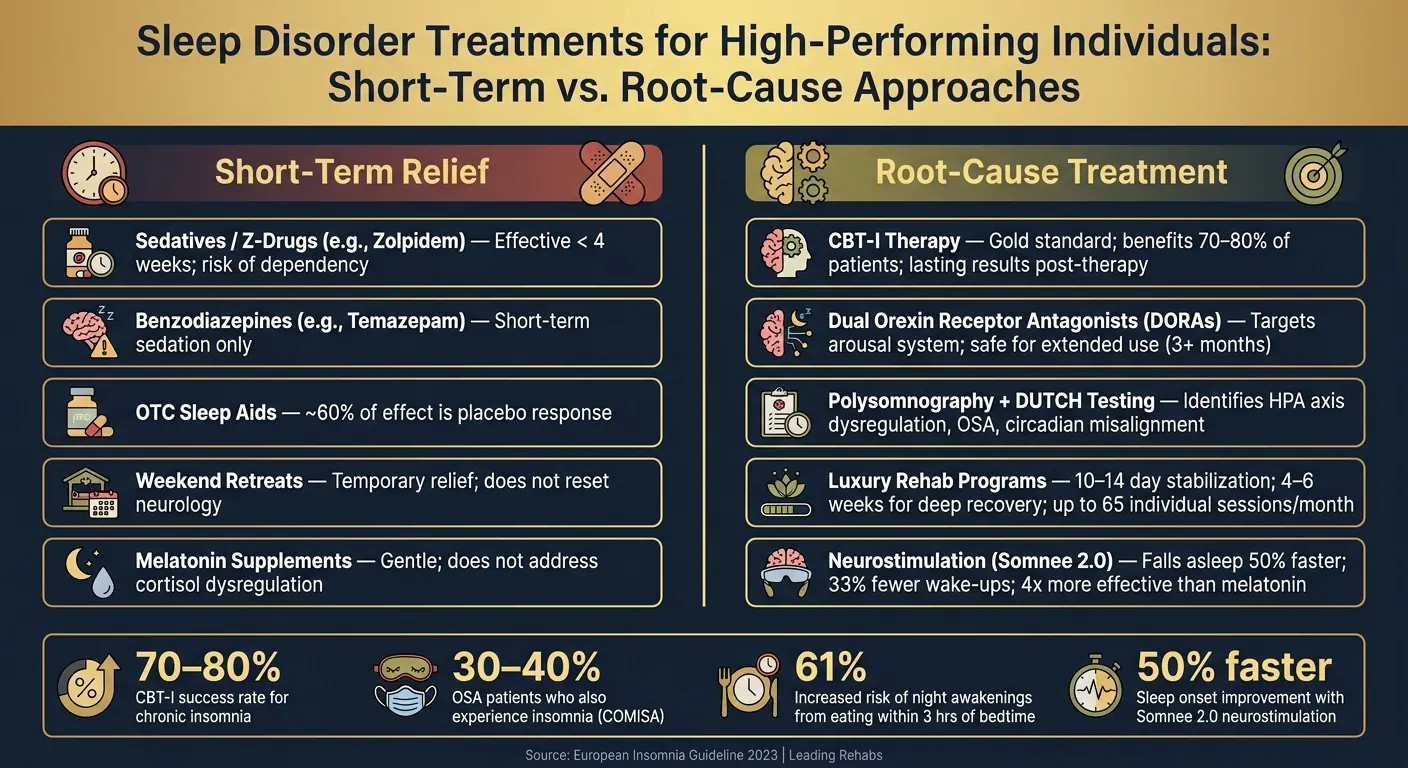
UHNWI Sleep Disorder Treatments: Short-Term Fixes vs. Root-Cause Solutions
Addressing insomnia in UHNWIs requires a nuanced approach that matches the complexity of its causes. Once the underlying factors are identified, treatment must be delivered with precision, offering privacy, flexible scheduling, and personalized care.
Diagnostic Tools and Targeted Therapies
Diagnosing sleep issues goes far beyond keeping a sleep diary. Advanced tools like Polysomnography (PSG) remain the gold standard, measuring brain activity (EEG), eye movements (EOG), muscle tone (EMG), and heart rhythm (ECG). This setup helps identify conditions like obstructive sleep apnea, REM disorders, and narcolepsy. For those preferring the comfort of home, Type 2 unattended PSG provides lab-quality results remotely.
A simpler option is WatchPAT, a home sleep apnea test (HSAT) that tracks arterial tone, oxygen levels, and actigraphy. It boasts a 94% sensitivity rate at detecting apnea events. For brain health insights, NeuroQuant® Brain MRI analysis offers FDA-approved measurements of brain regions tied to memory and executive function, catching subtle changes before symptoms appear.
Combining these diagnostics with multidisciplinary clinical reviews ensures a comprehensive understanding of the issue. Specialists in sleep medicine, psychophysiology, nutrition, and human performance collaborate to interpret results.
"The people I work with will spend thousands on bloodwork, coaching, and recovery tech, then accept an Oura score as the final word on their sleep. There was no serious way to actually assess sleep with the same precision we bring to everything else." - Andy Galpin, Professor & Human Performance Expert
These cutting-edge tools pave the way for integrated care strategies that address both the biological and behavioral sides of insomnia.
Medication and Integrated Care Options
A precise diagnosis is the foundation for effective treatment. Cognitive Behavioral Therapy for Insomnia (CBT-I) is considered the gold standard for chronic insomnia. Recommended by both the American Family Physician and the European Insomnia Guideline 2023, it tackles the thoughts and behaviors that fuel poor sleep and pairs well with medication when needed.
Dual Orexin Receptor Antagonists (DORAs), such as daridorexant, lemborexant, and suvorexant, are favored for managing both sleep onset and maintenance. Unlike older medications like Z-drugs or benzodiazepines, DORAs work by targeting the brain's arousal system without broadly suppressing the central nervous system, making them safer for extended use. For older adults primarily dealing with sleep onset issues, melatonin agonists like ramelteon offer a gentler option with minimal side effects.
| Medication Class | Examples | Recommended Duration | Primary Use |
|---|---|---|---|
| Orexin Antagonists | Daridorexant, Lemborexant | Up to 3 months+ | Sleep onset & maintenance |
| Melatonin Agonists | Ramelteon, Prolonged-release | Up to 3 months | Sleep onset (especially for 55+) |
| Z-Drugs | Zolpidem, Eszopiclone | < 4 weeks | Acute sleep onset |
| Benzodiazepines | Temazepam, Triazolam | < 4 weeks | Short-term sedation |
Since 30% to 40% of patients may not fully recover with a single approach, integrated care often becomes essential. This involves addressing co-existing issues like anxiety, ADHD, burnout, or substance reliance alongside insomnia.
Luxury Rehabilitation for Private Sleep Recovery
For UHNWIs, sleep issues often intersect with high-stress lifestyles, substance use, or burnout. In such cases, luxury rehabilitation centers provide tailored, private care that outpatient settings cannot match. These programs emphasize privacy and confidentiality as standard practice.
Rehabilitation programs typically start with a 10–14 day stabilization phase, while deeper recovery may require 4–6 weeks or longer. Clients receive one-on-one therapy, with some programs offering up to 65 individual sessions per month. Plans are customized to accommodate professional obligations, including secure workspaces and scheduled "device windows" to maintain business continuity. Treatments often integrate CBT-I with techniques like TRE (Tension & Trauma Releasing Exercises), breathwork, and light therapy designed around individual chronotypes.
"Environment influences regulation, sleep, and engagement in treatment... Hospitality exists to remove stressors and protect privacy - not to distract from treatment." - THE BALANCE Rehab Clinic
For those seeking such programs, resources like Leading Rehabs provide detailed profiles of facilities worldwide, allowing UHNWIs to evaluate options discreetly and on their own terms.
Practical and Technology-Based Solutions for Better Sleep
Building on advanced diagnostics and luxury rehabilitation options, practical and tech-driven strategies offer everyday solutions for sustained sleep improvement.
Wellness Retreats and Integrative Therapies
Sleep recovery programs tailored for ultra-high-net-worth individuals (UHNWIs) focus on addressing the entire system rather than isolated factors. Retreats that combine clinical diagnostics with therapies aimed at nervous system repair often deliver long-lasting results.
For instance, the Privé-Swiss Brain Health & Optimal Longevity Program incorporates sleep architecture engineering, metabolic adjustments, and stress biology. Pricing ranges from $12,500 for intensives to $80,000 for a 10-day program. Similarly, RAKxa Wellness offers 5-night Sleep Enhancement programs starting at $6,400 for double occupancy. These retreats utilize advanced tools like HRV monitoring, epigenetic clocks for assessing biological age, and neurofeedback to tackle the physiological causes of poor sleep.
Practical techniques such as Yoga Nidra, Tension & Trauma Releasing Exercises (TRE), and exposure to morning light help reset circadian rhythms. Evening routines - referred to as "wind-down gates" - include practices like warm-dim lighting, journaling, and avoiding screens 60–90 minutes before bedtime. Post-retreat, participants often receive a detailed 90-day to 12-month guide to maintain their improved sleep patterns.
"Burnout isn't a badge of honour - it's a clinical condition characterised by chronic HPA axis dysfunction, elevated cortisol, disrupted sleep architecture, and accelerated biological aging." - ResoHealth
Advanced Sleep Tracking and Smart Bedroom Tools
Modern sleep tools go beyond simply tracking sleep - they actively support the sleep process. The Somnee 2.0 headband, for example, uses personalized transcranial electrical stimulation (tES) to enhance the brain's natural sleep signals. It helps users fall asleep 50% faster, reduces overnight wake-ups by 33%, and adds about 30 minutes of sleep per night. These results are reported to be four times more effective than melatonin and 1.5 times more effective than Ambien.
For those who prefer a non-wearable option, the Withings Sleep under-mattress sensor tracks heart rate, breathing, and movement using pneumatic technology. Its accuracy has been validated against polysomnography. Another option, the 8 Sleep Smart Bed, dynamically adjusts mattress temperature throughout the night to optimize sleep architecture.
For chronic or more complex sleep issues, Absolute Rest offers at-home assessment kits with research-grade accuracy. These kits measure brain, heart, lung, and muscle activity at levels comparable to sleep labs and include 90 days of clinical guidance. Many of these devices also integrate with smart home systems, adjusting lighting and temperature automatically based on sleep patterns.
| Technology | Device/Program | Key Benefit |
|---|---|---|
| Neurostimulation | Somnee 2.0 | Falls asleep 50% faster; non-pharmacological |
| Smart Bed | 8 Sleep | Dynamic thermal regulation |
| Under-Mattress Sensor | Withings Sleep | No wearable; detects breathing disturbances |
| Clinical At-Home Kit | Absolute Rest | Sleep-lab data in your own bedroom |
These tools complement personalized diagnostics and integrated care by continuously monitoring and improving sleep patterns.
Short-Term Relief vs. Root-Cause Treatment
While innovative devices and retreats offer valuable insights and temporary relief, addressing the deeper neurological causes of poor sleep is essential. Short-term solutions - like sedatives or weekend retreats - may provide quick fixes but often fail to resolve the underlying issues. For high-performing individuals, such approaches can even worsen cycles of hyperarousal and sleep anxiety.
Root-cause treatments focus on rebuilding stable sleep cycles by addressing disrupted sleep as a learned neurological pattern. Techniques like CBT-I, neurofeedback, and AI-driven brainwave stimulation aim to reset these patterns. Stabilization typically takes 10–14 days, with lasting improvements requiring 4–6 weeks or more. Research-grade monitoring shows that biological changes often unfold over months rather than days.
"The modern guest doesn't want vague renewal - they want baseline testing, metabolic panels, sleep data, and evidence that the programme has worked." - Gavin de Souza, CEO of Dharana at Shillim
Conclusion: A Path to Lasting Sleep Recovery
For ultra-high-net-worth individuals (UHNWIs), persistent sleep problems often point to underlying challenges like chronic nervous system overactivation, HPA axis imbalances, burnout, or unresolved psychological stress. In these cases, insomnia isn't the root cause - it's a symptom of deeper issues.
This distinction is key when choosing a treatment approach. While short-term solutions like sedatives or melatonin can provide momentary relief, they don't address the underlying causes. Cognitive Behavioral Therapy for Insomnia (CBT-I) stands out as the gold standard, benefiting 70–80% of patients and delivering lasting results even after therapy concludes. When paired with precise diagnostics and structured aftercare - such as a 90-day sleep charter with travel protocols - this approach can reestablish consistent and restorative sleep.
Beyond diagnostics and treatment, a shift in perspective is equally important. Bill Gates emphasizes the value of prioritizing sleep as an essential part of daily life rather than treating it as expendable. This mindset, combined with clinical and holistic strategies, lays the foundation for long-term recovery.
"When sleep becomes an outcome of balanced living rather than something to be chased, it is far more likely to remain stable." - Dr. Shaji Pampalayam, Chief Wellness Officer at Dharana
These evidence-driven methods and mindset shifts are at the heart of the services provided by Leading Rehabs. Leading Rehabs connects UHNWIs with exclusive, clinically advanced programs. From private residential centers in Spain and Thailand to executive-focused facilities in Nashville, these programs offer the discretion, one-on-one care, and precision needed to achieve lasting sleep health through expert diagnosis and a dedicated team.
FAQs
How do I know if my insomnia is stress-related or a medical sleep disorder?
Determining the cause of insomnia - whether it's linked to stress or a medical issue - requires a professional assessment. Stress-related insomnia often improves once the source of stress is addressed. On the other hand, chronic insomnia lasts for at least three nights a week over a period of three months. Since insomnia can also be a symptom of other conditions, such as sleep apnea or mental health disorders, doctors may evaluate your sleep history, perform a physical exam, or suggest a sleep study to pinpoint the exact cause.
What tests should I ask for to find the real cause of my sleep problems?
Start by consulting your clinician for a thorough evaluation to pinpoint what's behind your insomnia. This process typically includes:
- Detailed Sleep History: Discuss your sleep patterns, habits, and any disruptions.
- Physical Exam: Rule out any underlying health conditions that might affect your sleep.
- Sleep Diary: Track your sleep for 1–2 weeks to identify patterns or triggers.
If necessary, ask about a sleep study to check for disorders like sleep apnea. Additionally, lab tests can provide valuable insights into potential contributors. These might include:
- 4-Point Salivary Cortisol: To assess stress hormone levels throughout the day.
- Ferritin Levels: To check for iron deficiencies.
- Thyroid Panel: To evaluate thyroid function.
- Fasting Glucose: To monitor blood sugar levels.
- Hormone Levels: Including progesterone, estradiol, and testosterone, which can influence sleep.
These steps can help uncover the underlying causes of your sleepless nights, paving the way for targeted solutions.
What’s the best long-term treatment if sleep hygiene and meds haven’t worked?
If improving sleep hygiene and trying medications haven’t helped, tailored clinical programs might offer more lasting solutions. These programs often integrate therapies such as ACT-I, which targets performance anxiety, alongside medical evaluations to rule out issues like sleep apnea. Treatments can involve circadian rhythm design, somatic practices like breathwork, and recovery-centered settings. The focus shifts from simply promoting rest to enhancing biomarkers and stabilizing the nervous system for better overall outcomes.