
Imposter Syndrome in Billionaires: Why Success Still Feels Fake

Even billionaires struggle with self-doubt. Despite their immense wealth and achievements, many ultra-wealthy individuals experience imposter syndrome - a persistent fear of being exposed as frauds. This psychological challenge affects 71% of U.S. CEOs and thrives on perfectionism, anxiety, and attribution errors, making even their greatest successes feel unearned.
Key Points:
- What is Imposter Syndrome? A mindset where individuals doubt their abilities despite evidence of success.
- Why Billionaires Feel It: Public scrutiny, isolation, and high stakes amplify self-doubt.
- Psychological Triggers: Perfectionism, anxiety, and distorted thinking patterns.
- Luxury Mental Health Solutions: Treatments like private therapy, biochemical restoration, and executive coaching help billionaires manage these feelings.
- Daily Strategies: Techniques like self-coaching, mindfulness, and reframing thoughts combat self-doubt effectively.
Success doesn’t erase imposter syndrome - it often magnifies it. But with the right tools and support, even the wealthiest can rebuild confidence rooted in reality.
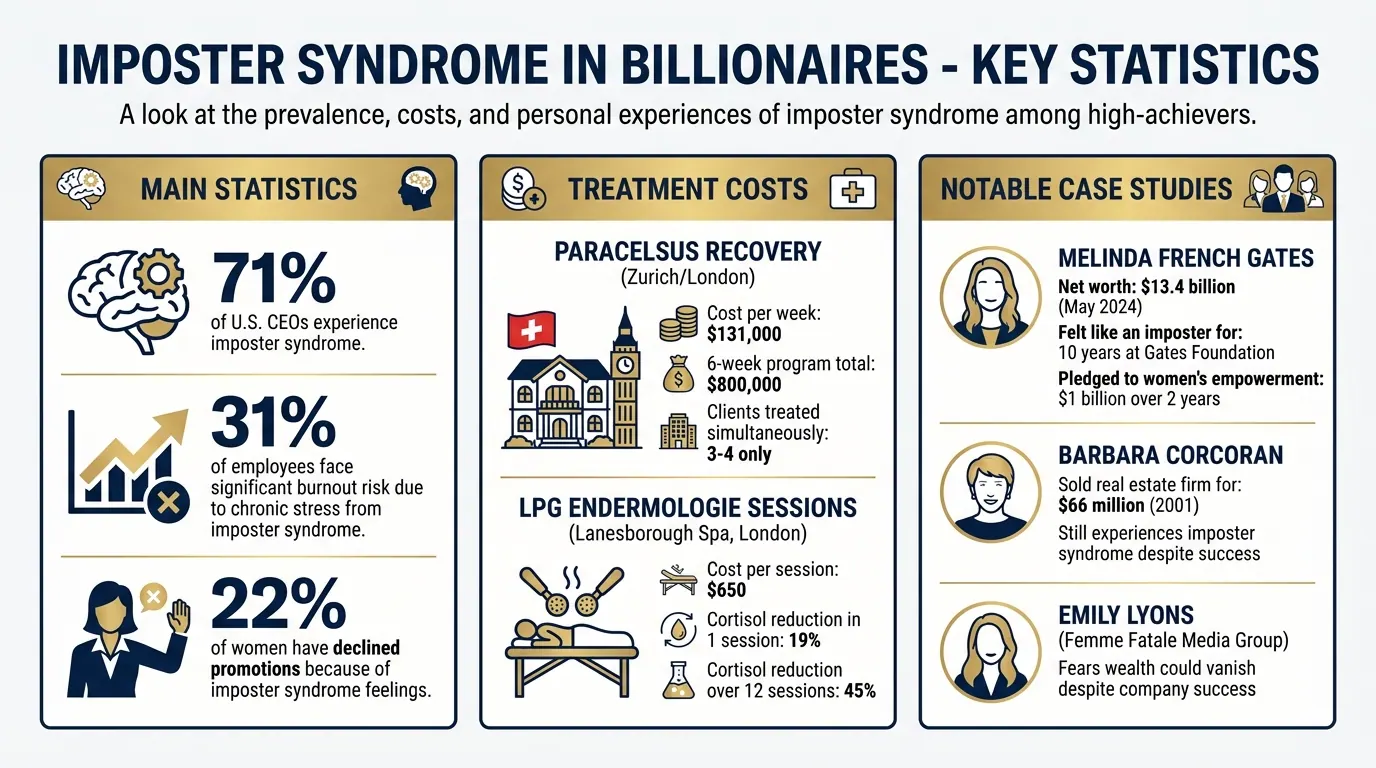
Imposter Syndrome Statistics and Treatment Costs for Ultra-Wealthy Individuals
Billionaire Hypnotist On How To Cure Imposter Syndrome
sbb-itb-4b13a7c
Psychological Causes of Persistent Self-Doubt
For billionaires, self-doubt often stems from mental patterns that distort their perceptions of success and failure. These thought habits can make even their grandest achievements feel uncertain while turning minor setbacks into overwhelming evidence of inadequacy.
Perfectionism and Attribution Errors
Many high achievers struggle with constantly "moving the goalposts." Once they reach a goal, they quickly dismiss it, insisting they "could have done better" or that the success wasn't meaningful enough. Take Mike Cannon-Brookes, the billionaire co-founder and CEO of Atlassian, as an example. In October 2017, he openly admitted that despite his accomplishments, he often feels like he doesn’t truly know what he’s doing and fears being "found out".
This perfectionism often goes hand-in-hand with black-and-white thinking. Even a nearly perfect project can be labeled a failure if it contains a single flaw. For instance, Barbara Corcoran, who sold her real estate firm for $66 million in 2001, shared in April 2023 that she sometimes dismisses her landmark deal as just a "lucky break" rather than a reflection of her skills. She summarized this tendency by saying:
"The more successful someone is, the more self-doubt they have, because that's what drives them. I've never met a secure person who was a stellar star."
These mental traps create a "fluke narrative" where success is attributed to luck, while failures are seen as proof of incompetence. But beyond these thought patterns, emotional responses also play a significant role in fueling self-doubt.
Anxiety and Brain Patterns
Anxiety often amplifies self-doubt by reinforcing the imposter mindset. It doesn’t just accompany feelings of inadequacy - it actively feeds them. Anxiety generates repetitive "fear stories", where one negative thought can spiral into a belief that even a small mistake could lead to career disaster.
A pessimistic explanatory style further deepens this issue, making setbacks feel permanent, all-encompassing, and deeply personal. In March 2026, Emily Lyons, founder of Femme Fatale Media Group, revealed that despite her company’s success, she often fears her wealth is just a fluke, something that could vanish at any moment.
Adding another layer is the Dunning-Kruger Effect. As billionaires gain expertise, their confidence can paradoxically decrease. Why? Because the more they learn, the more they realize how much they still don’t know. Ben Granger, Chief Workplace Psychologist at Qualtrics, explains:
"Where imposter syndrome comes in is when people really start to learn more and more about the topic, and their confidence level comes down. As they learn more, they're starting to realize and see [their work] in different contexts, and say, 'Wow, there's a lot that I don't know.'"
Case Studies: Billionaires Who Have Struggled with Imposter Syndrome
Even immense wealth and success can't shield someone from self-doubt. These stories show that even the most accomplished individuals can wrestle with feelings of inadequacy. Let’s take a closer look at two well-known examples.
Melinda French Gates: Balancing Philanthropy and Doubt
Melinda French Gates, with a net worth of about $13.4 billion as of May 2024, openly shared her experience with imposter syndrome during her first decade leading the Bill & Melinda Gates Foundation. On a podcast in May 2024, she admitted:
"I felt like an imposter for the first 10 years [at the Foundation]... I never felt qualified to 'speak credibly' about the foundation's work because I wasn't professionally trained in global health policy or medicine."
Despite managing billions of dollars for global health initiatives and engaging directly with communities, she often doubted her qualifications. It took a colleague’s recognition of her deep knowledge - earned through years of hands-on involvement - to help her appreciate her unique contributions. After stepping down as Co-Chair of the foundation in May 2024, she pledged $1 billion over two years to support organizations focused on women’s empowerment.
Elon Musk: Innovation and Quiet Self-Doubt
While Elon Musk hasn’t publicly discussed imposter syndrome, his leadership style hints at some of its hallmarks. Like many founders of billion-dollar companies, Musk is said to wrestle with fears of being perceived as a fraud - worrying that he might have misled investors or his team into taking bold risks. These feelings often surface during high-pressure moments, such as when a company reaches a $2 billion valuation, where both expectations and public scrutiny reach new heights.
Even for visionaries like Musk, the weight of responsibility can amplify self-doubt, showing how universal these feelings can be.
Luxury Mental Health Treatment for Billionaires
Custom Therapies and Treatment Programs
For billionaires grappling with imposter syndrome, mental health treatment goes far beyond the standard therapy session. These exclusive programs are designed to address the intense pressures of running billion-dollar enterprises while managing deep-seated self-doubt. Privacy is paramount for CEOs and public figures, which is why luxury facilities offer individualized accommodations and one-on-one programs to ensure absolute discretion.
Take Paracelsus Recovery, for instance, located in Zurich and London. This elite facility treats only three to four clients at a time, with costs reaching about $131,000 per week - meaning a six-week stay totals around $800,000. Clients receive highly personalized care, including a live-in therapist, private chef, and personal driver. Interestingly, Jan Gerber, the clinic's founder, checked himself in for acute depression and burnout in December 2022 after 12 years of working with ultra-wealthy clients. His personal experience led to the addition of shiatsu and breathwork to the clinic's offerings.
The treatment programs combine various tailored approaches. For example, integrative counseling blends insight, psychodynamic, and cognitive-behavioral therapies to tackle issues like perfectionism and compulsive overworking. For executives caught in cycles of stimulant use during the day and sedatives at night, Executive Detox programs offer 10-day stabilization protocols. Biochemical restoration treatments also play a key role, using genetics and lab tests to create customized nutrition plans, supplements, and IV infusions to rebalance the body’s chemistry.
Physical grounding techniques are another essential element. Dr. Galyna Selezneva employs the "Vitality-Stress-Sleep" (VSS) protocol at the Lanesborough Spa in London, utilizing the LPG Endermologie device. Each session, priced at about $650, has been shown to reduce cortisol levels by 19% in a single session and up to 45% over 12 sessions. Additionally, executive coach Regina Gerbeaux works with founders to shift their focus from business strategies to developing a stronger sense of self-worth. For example, she conducted a two-hour session with the founder of a $5 billion company to address these deeper issues.
"Unlike fatigue and stress, burnout isn't just about low energy, it is about a shift in identity and motivation."
– Dana Moinian, Psychotherapist, The Soke
For billionaires exploring these exclusive treatments, the key is identifying a facility that aligns with their unique clinical and privacy requirements.
Finding Treatment Centers Through Leading Rehabs
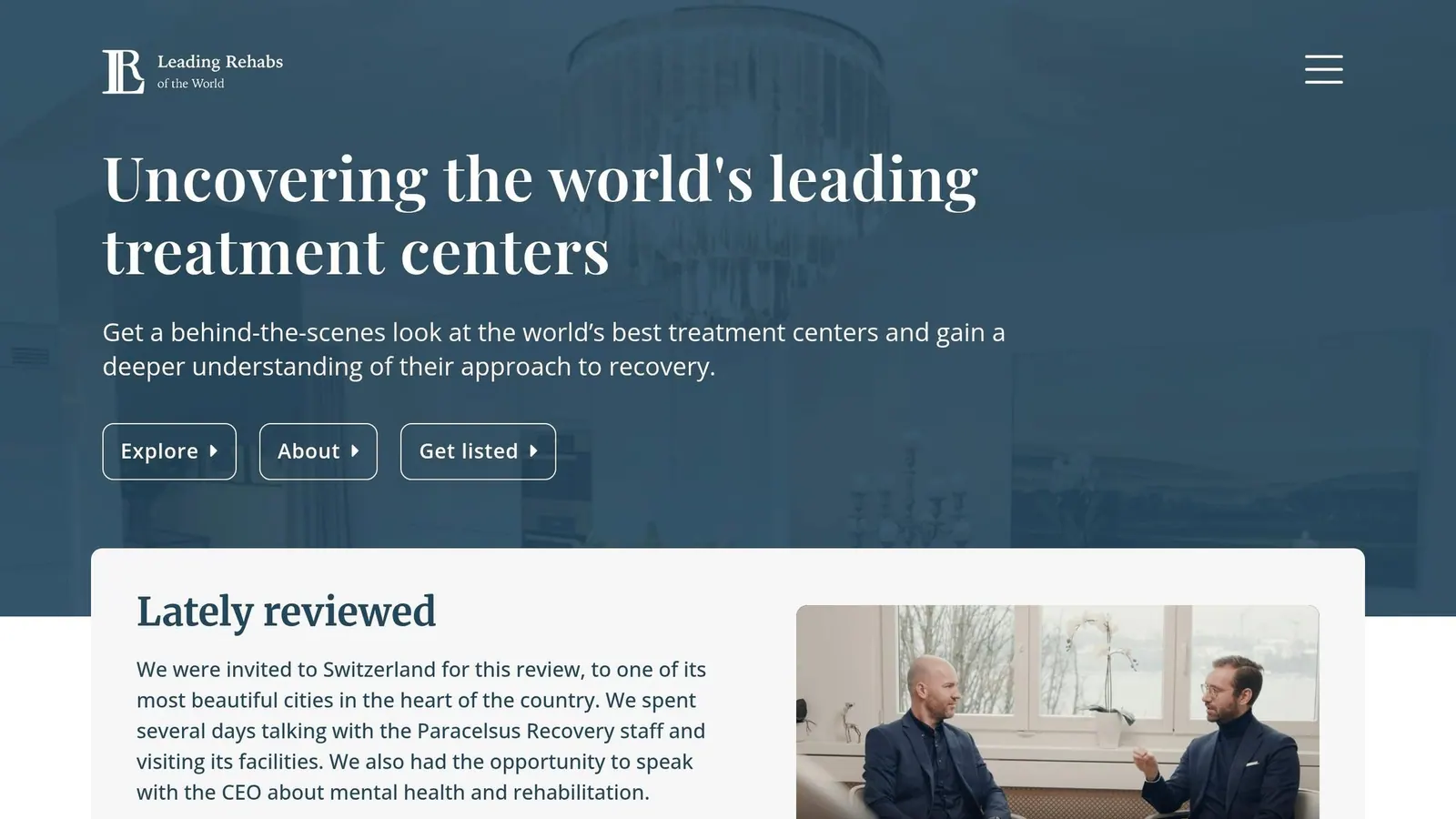
Once the treatment approach is defined, finding the right facility becomes critical for long-term recovery. Leading Rehabs serves as the go-to platform for billionaires seeking specialized mental health care for imposter syndrome and related challenges. The platform provides in-depth profiles of top treatment centers worldwide, detailing their unique therapies, approaches, and professional expertise.
Through Leading Rehabs, clients can explore comprehensive information about facilities that focus on imposter syndrome, including their privacy measures, therapeutic techniques, and pricing details. Premium listings even feature on-site reviews, video walkthroughs, and podcasts that give a first-hand look at what each center offers. This level of transparency is especially important for high-profile individuals who require both effective treatment and strict confidentiality.
The platform also allows users to compare options, review verified centers, and directly connect with facilities tailored to their needs. Whether someone is looking for a six-week residential program or targeted executive coaching, Leading Rehabs simplifies the process of finding treatment that fits both psychological goals and lifestyle preferences.
How to Overcome Imposter Syndrome
The 'Yet' Mindset
Sometimes, a single word can completely change your perspective. Take "yet", for example. When a successful entrepreneur says, "I don't have the network to scale this venture", adding "yet" transforms the statement from a fixed limitation into a temporary challenge. This subtle shift acknowledges that self-doubt reflects a momentary skill gap, not a permanent flaw in who you are.
Clare Josa, an expert on imposter syndrome, explains this distinction perfectly:
"Imposter syndrome... is actually about who we think we are rather than what we can and can't do. And that secret sauce is about the fear of being found out is not good enough or somehow a fraud".
The "yet" mindset embraces discomfort as a natural part of personal growth, not as proof of inadequacy. As executive coach Regina Gerbeaux puts it:
"Discomfort doesn't represent inadequacy or mean you're an imposter; discomfort signifies growth".
This way of thinking naturally leads to practical strategies for managing self-doubt and building confidence.
Self-Coaching and Daily Mindfulness Practices
One effective way to quiet self-doubt is through self-coaching techniques, like labeling intrusive thoughts. For instance, when your inner critic says, "You're deceiving your team" or "This success is just luck", give that voice a name - like "Gertrude." By labeling it, you create distance between yourself and those thoughts, reducing their power.
Mindfulness can also help during moments of spiraling doubt. A simple breathing exercise - deeply inhaling through your nose and exhaling audibly - can interrupt the body's stress response. Imposter syndrome often triggers a "fight or flight" reaction, flooding your system with adrenaline and cortisol, which can lead to burnout or even insomnia.
Real-life examples show how these practices work. One leader described how she overcame years of doubt by focusing on reminders of her competence. Another entrepreneur used visualization techniques to stay grounded, eventually selling her company for $66 million in 2001.
A skills-based self-assessment can also provide clarity. By rating your abilities on a scale from 1 to 5, you replace vague feelings of inadequacy with concrete data. As Stephanie Zepeda, Ph.D., explains:
"The financially anxious heart is soothed by data".
While these daily practices can make a big difference, structured support from executive therapy programs can tackle deeper issues.
Executive Therapy Programs
Executive therapy programs focus on reshaping the way you view your achievements. They help leaders separate earned success from the idea of "getting lucky". These programs also differentiate between skill gaps - which can be addressed - and perceived flaws in character, reframing discomfort as a natural part of growth.
For instance, Emily Lyons, CEO of Femme Fatale Media Group, used cognitive restructuring to overcome her childhood financial anxieties. She learned to see her wealth as something she had earned, rather than a stroke of luck. Reflecting on this journey, she shared:
"Success doesn't heal you. It just gives you the resources to finally start".
These programs also address behavioral patterns tied to imposter syndrome, like perfectionism, procrastination, project paralysis, and people-pleasing - known as the "Four P's". The stakes are high: 31% of employees face a significant risk of burnout due to chronic stress from imposter syndrome, and 22% of women have declined promotions because of these feelings.
Instead of focusing on short-term fixes, these programs aim to address the root causes of self-doubt. By working on the brain's stress response, they help leaders build lasting confidence based on self-awareness, rather than external approval.
Conclusion: Building Real Confidence
Imposter syndrome doesn’t magically vanish when someone’s net worth skyrockets into eight or nine figures. In fact, the pressures that come with immense success often amplify self-doubt, leaving even the wealthiest individuals grappling with feelings of inadequacy.
But change is possible. Overcoming self-doubt starts with understanding its roots. True confidence isn’t about external validation - it’s about recognizing your achievements as the result of your own skills and effort, not just luck. Often, this shift in mindset benefits from professional guidance, whether through executive coaching, specialized therapy, or luxury mental health programs that cater to the unique challenges of extreme wealth.
For ultra-high-net-worth individuals, finding the right support system is essential. Leading Rehabs connects these individuals with top-tier treatment centers that specialize in addressing the psychological struggles tied to high-level success. These programs focus on issues like guilt and the fear of public scrutiny, providing a safe space to work through deeply personal challenges.
Combining professional help - such as executive coaching and tailored therapies - with personal strategies like cognitive restructuring and honest self-assessment can help billionaires confront and manage self-doubt. As part of luxury mental health care, these integrated approaches offer a path forward. Regina Gerbeaux encapsulates this journey perfectly:
"Discomfort doesn't represent inadequacy or mean you're an imposter; discomfort signifies growth".
FAQs
How can I tell imposter syndrome from healthy humility?
Imposter syndrome is marked by ongoing self-doubt and a nagging sense of being a fraud, even when there's clear evidence of success. This often results in emotional strain and a constant fear of being "found out."
On the other hand, healthy humility offers a more balanced perspective. It allows someone to recognize their limitations without dismissing their accomplishments. This mindset encourages confidence while staying open to learning and personal growth. The main distinction between the two lies in how self-doubt manifests - whether it's irrational and unrelenting or constructive and measured.
Why does success make imposter feelings worse?
Success often intensifies imposter syndrome. With greater achievements come increased visibility, higher expectations, and mounting pressure to deliver without flaws. For high achievers, these new challenges can spark fears of inadequacy, leaving them questioning whether they truly deserve their accomplishments. Perfectionism only adds fuel to the fire - every misstep can feel like undeniable evidence of being a fraud. Even billionaires aren’t immune to these feelings, proving that self-doubt doesn’t vanish with success; in fact, it can grow alongside it.
What’s the fastest daily practice to stop a self-doubt spiral?
The fastest way to break free from a self-doubt spiral is to see those feelings as a natural part of achieving success. Instead of letting self-doubt hold you back, use it as fuel to grow and get better. By changing how you view uncertainty, you can transform it into a powerful motivator for progress.