
Identity Beyond Wealth: Who Are You When Success Is No Longer the Goal?

When success stops being your main focus, it can feel unsettling. High achievers often tie their identity to accomplishments, titles, and wealth. But what happens when those markers lose their meaning?
Here’s the reality: financial success solves money problems but doesn’t address deeper emotional needs. Many feel empty after reaching major milestones - a phenomenon called the Arrival Fallacy, where achieving goals doesn’t lead to lasting fulfillment.
Key points to consider:
- Why this happens: Success often becomes your entire identity. When it’s gone, you may feel lost or anxious.
- Common triggers: Retirement, career shifts, or selling a business can lead to identity crises.
- The problem with wealth: Material success doesn’t create meaning or answer the question, “Who am I without my achievements?”
To move forward, reflect on your values, explore new roles, and focus on emotional well-being. Therapeutic approaches like Internal Family Systems and mindfulness practices can help rebuild a balanced sense of self. Remember: your identity isn’t just your résumé - it’s who you are beyond it.
Rethinking Money, Identity and Fulfillment, with Jane Bond
When Success Stops Being Enough
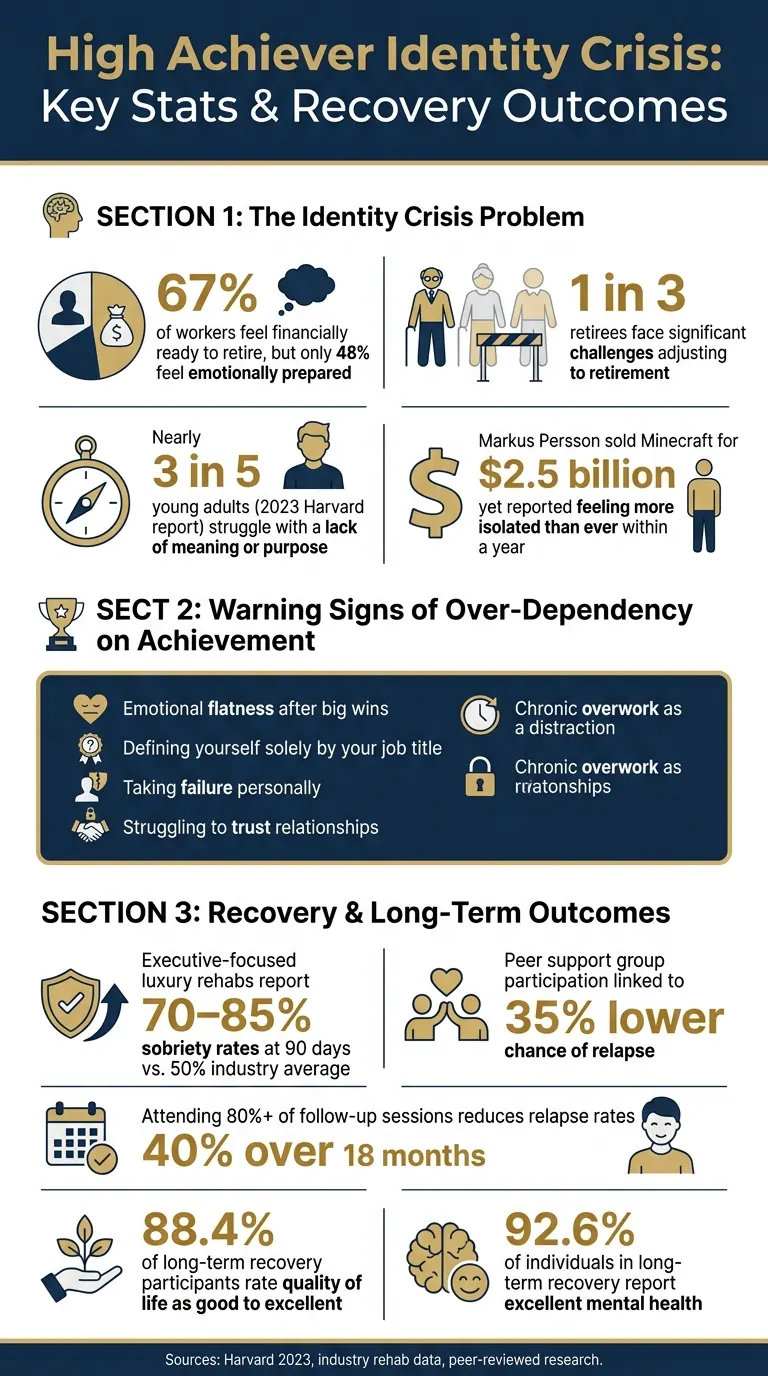
High Achiever Identity Crisis: Key Stats & Recovery Outcomes
Let’s dive deeper into why high achievers often feel unmoored when accomplishments lose their meaning, building on the earlier discussion about empty milestones.
The Psychological Impact of Tying Identity to Success
For many high achievers, success isn’t just a part of their lives - it becomes their entire identity. This phenomenon, known as role engulfment, occurs when a single role, like a professional title, overshadows every other aspect of a person’s life. Over time, work begins to dominate, eroding personal relationships, hobbies, and even core values. Researchers often describe this as a diminishing sense of self.
When that role is disrupted or removed, the brain doesn’t treat it as just another life transition. Social psychologist William Swann, PhD, explains:
"Identity fusion activates the same neural threat-detection circuitry as physical danger - meaning the psychological stakes are neurologically equivalent to survival."
This explains why losing a professional identity can feel like a life-or-death crisis. Physical symptoms like fatigue, chest tightness, or an overwhelming sense of dread often emerge. These are soon followed by emotional struggles, including anxiety, depression, and an unsettling emptiness.
What Triggers an Identity Crisis in High Achievers
Identity crises don’t usually result from a single dramatic event. Instead, they tend to creep in when the external markers of success disappear, leaving individuals without the familiar framework that once supported their sense of self.
Liquidity events are a common trigger. Take Markus "Notch" Persson, the creator of Minecraft, as an example. After selling the game to Microsoft for $2.5 billion, he bought a $70 million mansion and hosted lavish parties. Yet, within a year, he admitted to feeling more isolated than ever. As he put it:
"The problem with getting everything is you run out of reasons to keep trying, and human interaction becomes impossible due to imbalance."
Retirement is another high-risk period. While 67% of workers feel financially ready to retire, only 48% feel emotionally prepared. Around 1 in 3 retirees face significant challenges adjusting to this new phase of life. Burnout and forced career breaks can also disrupt routines and social ties, while the rapid rise of AI threatens professionals whose sense of value is tied to specialized expertise.
These moments of instability highlight why external achievements alone can’t satisfy deeper, more personal needs. Understanding these triggers is a crucial first step toward rebuilding a sense of self.
Why Material Success Fails to Fulfill Deeper Needs
Material success can answer the question, "What do you do?" but it doesn’t address "Why does it matter?" or "Who are you without it?"
This disconnect is largely due to hedonic adaptation - a tendency to return to a baseline level of happiness after major life changes. A $10 million payout, a prestigious title, or a feature in Forbes might feel exhilarating at first, but over time, these accomplishments become the new normal. The goalpost keeps moving, leaving the underlying emptiness unaddressed.
A 2023 Harvard report revealed that nearly three in five young adults struggle with a lack of meaning or purpose. Often, this stems from "achieving to achieve" without a deeper internal connection. As psychotherapist Mark Shelvock observed:
"The question is not what to achieve next; it is whether you are ready to ask what you have been achieving for."
While material success can solve external problems, it doesn’t create meaning, strengthen relationships, or answer the fundamental question of who you are when the accolades and titles fade away.
How Wealth and Achievement Shape Identity
Building on the earlier discussion of identity crises, let's explore how wealth and achievement influence your sense of self.
The Role of External Validation
When your self-worth hinges on success, it often relies on external markers like job titles, income, media recognition, or approval from peers. The problem? External validation is unpredictable, which can leave your sense of self feeling shaky unless it's constantly reinforced.
This drive for validation often stems from deeper emotions like fear, insecurity, or even shame. Success becomes a way to mask these feelings. As Paracelsus Recovery explains, "Wealth 'others' us, distorting our relationships and eroding trust." Instead of fostering real fulfillment, this dynamic can lead to a relentless pursuit of accolades and possessions.
The Psychological Effects of Role Engulfment
When your professional role overshadows every other part of your identity, any disruption can feel like losing the foundation of who you are. Psychotherapist Annie Wright, LMFT, describes this phenomenon:
"The self hasn't been damaged. It's been emptied of its primary organizing content."
This emptiness often pushes high achievers to overwork, as if staying busy can preserve their sense of identity. These struggles often surface in specific, recognizable ways.
Warning Signs of Over-Dependency on Achievement
Relying too heavily on external success can manifest in several ways:
- Emotional flatness after big wins. Major achievements provide fleeting satisfaction because the bar for success keeps moving.
- Defining yourself solely by your job. It feels awkward or empty to describe yourself outside of your professional accomplishments.
- Taking failure personally. As Annie Wright notes, "When your job and your self are this fused, a bad performance review doesn't just feel like professional feedback - it feels like a verdict on whether you deserve to exist."
- Chronic overwork as a distraction. Staying perpetually busy becomes a way to avoid deeper questions about purpose and meaning.
- Struggling to trust relationships. There's a lingering fear that people value you more for your status or resources than for who you truly are.
Recognizing these patterns is the first step toward building a more balanced and grounded sense of identity. By addressing these tendencies, you can begin to shift focus from external markers to what truly matters.
How to Rebuild Identity Beyond Wealth
Rebuilding identity after prioritizing wealth requires thoughtful reflection and intentional steps. Here's how to approach it.
Clarifying Core Values
It's easy to list professional goals, but identifying what you genuinely value in life can be more challenging. Acceptance and Commitment Therapy (ACT) offers a helpful perspective here. According to Annie Wright, LMFT:
"Values are defined as freely chosen, verbally constructed consequences of ongoing patterns of activity - not goals to achieve but directions to move toward."
Start by conducting a financial identity audit. Ask yourself questions like, "What financial role am I playing right now?" or "What do I want my current choices to reflect?" Similarly, an energy audit can help you pinpoint which interactions uplift you and which leave you drained. This process often reveals hidden conflicts between your current lifestyle and what you truly care about.
Even small shifts can make a big difference. For instance, changing how you describe yourself - from "I am a [title]" to "I work as a [title]" - creates a subtle but impactful separation between your identity and your job. Once you have a clearer understanding of your values, targeted therapeutic approaches can help bridge the gap between who you are now and who you aspire to be.
Therapeutic Approaches for Identity Work
Certain therapeutic methods are particularly effective for addressing identity challenges in high achievers.
Internal Family Systems (IFS) is one such approach. It identifies parts of your personality, like the "Achiever Part", which may have developed as a protective mechanism to feel safe or valued through performance. Annie Wright explains:
"The Achiever Part is not a villain; it is a brilliant protector that learned to do an impossible job."
By understanding this part rather than trying to eliminate it, you can loosen its hold and allow a more balanced sense of self to emerge.
Acceptance and Commitment Therapy (ACT) complements this by helping you build an identity with multiple "load-bearing walls", so your sense of self remains stable even when one aspect of life changes. Meanwhile, narrative therapy helps you craft a meaningful life story that doesn't rely solely on a linear career path. For those grappling with a lack of meaning - what Viktor Frankl, MD, PhD, described as an "existential vacuum" - psychodynamic and existential therapies can help uncover the deeper sources of emptiness.
Mindfulness and Emotional Regulation Practices
Therapeutic work can reshape your identity, but mindfulness practices are essential for maintaining emotional balance and self-awareness.
High achievers often use productivity as a way to manage anxiety, staying constantly busy to avoid discomfort. However, this strategy has limits. Dr. Andrea Gleim, Licensed Psychologist and Founder of Mindfully Mine Counseling Center, explains:
"Constant busyness prevents you from noticing what you truly feel or need."
Somatic practices, such as breathwork, yoga, or movement-based therapies, are particularly effective for high achievers. Chronic stress often manifests physically, not just mentally, and these practices help retrain the nervous system to handle stillness. This is crucial for those whose brains equate non-performance with danger.
Another powerful yet simple tool is self-compassion practice, based on the model developed by Kristin Neff, PhD. It includes three components: mindfulness (acknowledging your experiences without suppressing them), common humanity (recognizing that struggle is universal), and self-kindness. Research shows that self-criticism activates the brain's threat system, keeping you trapped in a cycle of stress. Practicing self-compassion can help break this loop.
Building a Psychologically Rich Life
When material success feels hollow, it’s time to enrich other aspects of your identity. Rebuilding isn’t just about letting go of outdated roles; it also involves adding new dimensions to your sense of self. Psychologists often describe this as expanding the "container of self" to include roles beyond your career, such as friend, artist, traveler, or community member.
This shift doesn’t mean abandoning ambition. Instead, it’s about spreading your identity across multiple areas so that no single setback can destabilize you. Small, intentional choices - like saying no when you’d usually say yes, sharing work before it feels perfect, or setting aside unstructured time - help reinforce this broader sense of self.
"Before you can be seen differently, you must become different within yourself." - Doris Roach
sbb-itb-4b13a7c
The Role of Luxury Rehabilitation in Identity Change
High achievers often put off seeking treatment because they’re worried about their reputation and the impact on their careers. Anthony Saracino of Safe Haven Behavioral Health puts it this way:
"For the high-profile professional, the decision to seek treatment is paralyzed by two massive barriers: Privacy (fear of reputational ruin) and Career Continuity (fear of the business collapsing)."
Luxury rehabilitation programs recognize that burnout and other struggles often stem from a fractured sense of self. That’s why these programs focus on helping individuals rebuild their identity, addressing the deeper psychological challenges rather than just treating surface-level symptoms.
What to Expect from Luxury Rehabilitation
These high-end programs go well beyond traditional addiction treatment. They tackle issues that are common among high achievers, such as imposter syndrome, executive burnout, high-functioning anxiety, and the loneliness that can come with professional success. From the very start, identity reconstruction is woven into the treatment process alongside clinical care.
The environment is designed to prioritize privacy and personalized attention. Many centers cater to a small number of clients - usually between 7 and 25 beds - to ensure discretion and tailored care. Some facilities even offer up to 65 individual therapy sessions each month, led by highly trained doctorate-level therapists. For those worried about work disruptions, these programs allow secure workspaces and supervised device access after detox, addressing concerns about career continuity.
Treatment isn’t limited to traditional therapy sessions. Experiential approaches like equine therapy, art and music therapy, and nature-based healing help clients reconnect with parts of themselves that may have been buried under years of professional pressure. The goal isn’t to step away from ambition but to create a sustainable path forward. As THE BALANCE Rehab Clinic explains:
"Recovery is not viewed as stepping away from ambition, but as a way to sustain it over the long term."
The results speak for themselves. Executive-focused luxury rehabs report 90-day sobriety rates of 70% to 85%, significantly higher than the industry average of 50%. With these comprehensive services, platforms like Leading Rehabs simplify the process of finding care that meets both clinical and professional needs.
How Leading Rehabs Helps You Find the Right Care
Once you understand the benefits of luxury rehabilitation, the next step is finding the right program. With so many options offering different approaches, privacy levels, and specialized services, it can feel overwhelming. That’s where Leading Rehabs comes in. They provide detailed profiles and insights into top-tier treatment centers around the world, making it easier to find a program that fits your personal and professional requirements. Instead of navigating this process alone, you can compare facilities side by side, review verified information, and see exactly what each center offers - all before reaching out.
Maintaining a New Identity After Treatment
Rebuilding a secure sense of self through tailored luxury rehabilitation is a significant achievement. But the real challenge lies in maintaining that identity once treatment ends. Leaving a structured rehab program is a pivotal moment, yet it’s also when the hard work truly begins. Studies reveal that relapse rates for substance use disorders range from 40% to 75% within the first six months after treatment. For high achievers stepping back into demanding careers, a clear plan is essential to protect the progress made during recovery.
Building Long-Term Support Systems
The greatest risk after rehab isn’t a lack of determination - it’s the absence of ongoing support. Experts call this the "Cliff Effect": the sudden drop from intensive care to minimal support can lead to old habits resurfacing. A transitional living program lasting 30 to 90 days can act as a buffer, helping individuals face real-life pressures without immediately returning to environments tied to past behaviors.
Effective support systems are layered and diverse. A multi-tiered team - including a psychiatrist, psychologist, recovery coach, and mentor - addresses different aspects of recovery simultaneously. For professionals, adding executive coaching to this mix is particularly helpful. It not only fosters mental health awareness but also aids in setting workplace boundaries. Dr. Farrukh Alam, Medical Director at Harbor London, explains:
"Thriving over time in recovery is less about acute symptom relief and more about embedding adaptive habits, supportive networks, and renewed identity across years."
Peer connections also play a critical role. Participation in peer support groups has been linked to a 35% lower chance of relapse compared to other treatment approaches. For those in high-pressure careers, connecting with peers who understand the unique challenges of professional life creates a network that balances performance with personal well-being.
These structured systems lay the foundation for redefining success in a way that aligns with a healthier, more sustainable identity.
Setting New Metrics for Success
As you move forward, redefining what success means is key to maintaining stability. Traditional measures, like wealth or status, often reinforce harmful patterns. Instead, focus on emotional balance, meaningful relationships, and aligning daily actions with your core values. Let these values guide your new definition of success, ensuring that your achievements reflect who you truly are.
A helpful exercise is creating a personal mission statement - a private declaration of what brings you joy and how you want to be remembered. This isn’t a professional bio but a personal compass. Pair this with an "energy audit", a practice of tracking activities that energize or drain you. Over time, these insights reveal what your evolving identity truly needs.
"Authority grows when your identity is no longer dependent on constant performance." - Michelle Gines, Founder of Purpose Publishing
For those in long-term recovery, 88.4% rate their quality of life as good to excellent, and 71.1% report positive financial situations. This shows that stepping away from achievement-driven metrics doesn’t mean sacrificing a fulfilling life.
Identity Change as a Lifelong Practice
Rebuilding your identity isn’t something that happens in a month-long program - it’s an ongoing journey. As Changes Treatment Center puts it:
"Identity is reinforced daily through consistent, small actions that ground you in who you're becoming."
Redefining success involves prioritizing emotional well-being and relationships over traditional measures. Small daily habits, like 10-to-30 minutes of journaling or a regular movement practice, provide the foundation for reshaping your sense of self. Practices like yoga, mindfulness, and breathwork help you stay connected to your body and avoid the cognitive overdrive many high achievers rely on.
Structured aftercare can double the chances of sustained recovery. Attending at least 80% of follow-up sessions reduces relapse rates by 40% over 18 months. It’s consistency, not intensity, that ensures lasting change.
Conclusion: Living Beyond Wealth
Wealth can open doors, but it doesn’t define who you are. For many high achievers, the realization that success alone isn’t fulfilling marks the beginning of a more meaningful journey - one centered on values instead of external validation. This shift from seeking approval to finding inner fulfillment is a key step in living beyond material constraints.
This isn’t about giving up ambition - it’s about channeling it differently. Mike Brown, founder of Unbreakable Wealth, puts it plainly:
"No matter your level of success, those thoughts of 'I'm not enough' and 'what is my real purpose' don't go away. They plague you. And if you listen, they'll consume you."
Change is possible, but it requires effort. For example, 92.6% of individuals in long-term recovery report excellent mental health. This level of transformation doesn’t happen overnight; it’s the result of intentional work, such as clarifying values, seeking therapeutic support, and building a life that aligns with who you truly are.
Programs tailored for executives show promising outcomes. As Oceans Luxury Rehab explains:
"The executive who seeks treatment early usually preserves more than sobriety. Career stability, family trust, and decision-making capacity are often still recoverable."
If you're ready to take that step, Leading Rehabs connects you with top-tier treatment centers that prioritize privacy, depth, and lasting change. Your future isn’t defined by your wealth - it’s shaped by the choices you make and the person you decide to become.
FAQs
How do I know if my identity is too tied to success?
Signs that your sense of self might be too closely linked to success can show up in a few key ways. For instance, you might feel like a bad performance at work defines your personal worth, or you could experience a sense of emptiness even after reaching big milestones. If you believe your value is tied solely to your job title or income, that's another red flag.
Other signs include constantly overworking as a way to avoid reflecting on deeper questions about your purpose, having a social circle that mostly consists of professional connections, or even dealing with physical issues like fatigue or muscle tension that stem from career-related stress. These patterns can be subtle but are worth paying attention to.
What should I do right after a big exit or retirement feels empty?
After a major exit or retirement, it’s common to feel a sense of emptiness. This often stems from losing the structure and identity tied to your previous role. Instead of diving headfirst into new ventures to fill the gap, take a step back. Use this time to discover what genuinely excites and motivates you.
Shift your focus inward - think about what you want to learn or how you’d like to make a difference. Establish a flexible daily routine that includes physical activity, mental challenges, and opportunities for social interaction. Therapy can also be a helpful tool to thoughtfully navigate this period of transition.
How can I find the right private rehab or therapy program as an executive?
For high-performing professionals, it's crucial to select programs that prioritize privacy, clinical excellence, and seamless integration with your professional responsibilities. Look for accredited facilities designed with a boutique approach, typically accommodating only 6–12 clients. Features like private entrances, staff bound by NDAs, and anonymous billing ensure discretion. Additionally, seek programs that offer supervised connectivity, allowing you to handle critical business matters while fully engaging in personalized, intensive treatment.