
High-Performance Anxiety: Customized Strategies for Sustained Excellence

High-performance anxiety is a persistent struggle many high achievers face. It’s not just stress - it’s the constant fear of failure despite outward success. This anxiety can lead to perfectionism, imposter syndrome, and burnout, all while affecting mental and physical health.
Key takeaways:
- Symptoms: Chronic overthinking, indecision, tension headaches, insomnia.
- Causes: Perfectionism, fear of failure, imposter syndrome, and workplace pressures.
- Impact: Elevated cortisol levels, impaired decision-making, and reduced creativity.
- Solutions: Cognitive-behavioral techniques, mindfulness, Acceptance and Commitment Therapy (ACT), and structured recovery time.
For those in high-pressure roles, personalized wellness plans and luxury treatment options provide tailored solutions. These include neurofeedback, executive coaching, and discreet rehabilitation programs designed for professionals. Addressing high-performance anxiety is not just about managing stress - it’s about creating a sustainable path to success without sacrificing well-being.
Confidence Under Pressure: Strategies for Overcoming Performance Anxiety
sbb-itb-4b13a7c
Understanding High-Performance Anxiety
High-performance anxiety isn’t an official clinical diagnosis, but it’s a very real experience for many people. It’s that constant, underlying tension that drives productivity while simultaneously creating internal distress.
Unlike stress, which is often tied to specific external pressures and tends to ease once a deadline or event passes, high-performance anxiety is more persistent. It clings to the next goal, presentation, or fear of failure. One way to think about it: ambition pushes you toward something, while anxiety pulls you away from something - like the fear of judgment, exposure, or not being enough. Traits such as hyper-vigilance and over-preparation, often celebrated in high achievers, can reinforce this cycle of anxiety. This tug-of-war between outward success and internal struggle shows up in both psychological and physical ways.
Common Psychological and Physical Symptoms
On the psychological side, high-performance anxiety is often rooted in perfectionism. This can lead to chronic overthinking and an overwhelming fear of making a career-ending mistake. Over time, this mental strain can result in what some call Cognitive Override Fatigue, where the brain’s decision-making abilities start to wear out.
Physically, this anxiety often manifests in ways like jaw clenching, tension headaches, shallow breathing, and insomnia. These symptoms reflect a nervous system stuck in overdrive, constantly bracing for the next challenge.
"High-functioning anxiety is like driving a car with the parking brake slightly engaged. You get where you're going... but the engine is working harder than it should." - Dr. Elsa Orlandini, Licensed Psychologist
How Anxiety Affects Performance and Health
When anxiety becomes chronic, it can keep cortisol levels elevated, which isn’t great for the body. Over time, this can damage neurons in the hippocampus (important for memory) and even speed up cellular aging due to telomere shortening.
From a performance standpoint, anxiety can lead to indecision, stifled creativity, and an over-controlling mindset. High achievers might second-guess decisions they used to make confidently, over-prepare to the point of diminishing returns, or struggle to delegate tasks. Ironically, the habits that once fueled their success can eventually hold them back.
Take the example of professional tennis player Emil Ruusuvuori. Despite being ranked #37 in the world, he battled panic attacks, dissociation, and even physical blackouts during matches. He described mentally “checking out” while his body kept going until it couldn’t anymore. Eventually, he had to take a 4.5-month break from the ATP Tour in 2024 to recover.
"Once I stepped on the court, I was able to just switch it off and focus on tennis... [but] all I wanted was to be somewhere else or somebody else." - Emil Ruusuvuori, ATP Tour Professional
These challenges, while significant on their own, are often compounded by the unique pressures faced by high-achieving individuals.
Pressures Specific to High-Achieving Professionals
For elite professionals and ultra-high-net-worth individuals, external pressures can amplify their internal struggles. Public scrutiny means that their mistakes aren’t private - they’re on display for boards, clients, the media, or even entire industries. High financial stakes add another layer of stress, as every decision feels like it carries enormous consequences. On top of that, the expectation of being constantly available leaves little time for genuine rest.
When professional success becomes intertwined with self-worth, any setback can feel like a personal failure. This is further complicated by what researchers call socially prescribed perfectionism - the belief that others expect flawless performance. This belief can take a heavy toll on mental health.
"Success becomes a mask. Athletes don't just carry their careers - they carry sponsors, family hopes, national pride, and relentless pressure to perform." - Michael Allison, Polyvagal Performance Consultant
To make matters worse, high achievers often face a social barrier when seeking help. Because they appear to "have it all", their struggles are frequently dismissed, pushing them to hide their difficulties and delaying the support they need.
Root Causes of High-Performance Anxiety
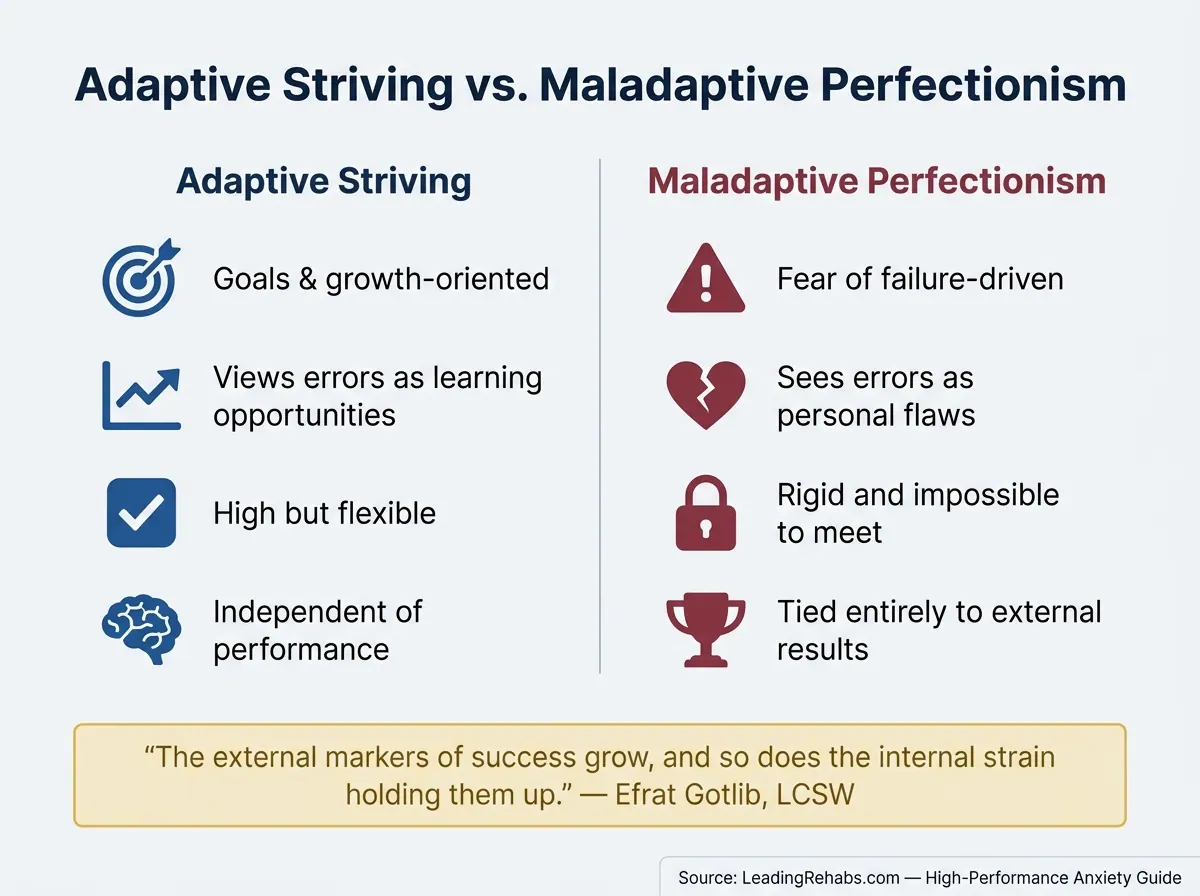
Adaptive Striving vs. Maladaptive Perfectionism: Key Differences
Understanding what drives high-performance anxiety is key to addressing it effectively. These causes are not random - they often stem from psychological patterns, personal identity, and external pressures.
Perfectionism and Fear of Failure
Perfectionism can take on different forms. On one hand, adaptive striving motivates individuals to aim for meaningful goals and treat mistakes as opportunities to learn. On the other hand, maladaptive perfectionism stems from an overwhelming fear of failure. Here, standards become rigid and unattainable, and even minor mistakes feel like personal flaws rather than natural parts of growth.
| Feature | Adaptive Striving | Maladaptive Perfectionism |
|---|---|---|
| Motivation | Goals and growth-oriented | Fear of failure-driven |
| Reaction to Mistakes | Views errors as learning | Sees errors as personal flaws |
| Standards | High but flexible | Rigid and impossible |
| Self-Worth | Independent of performance | Tied to external results |
This issue is often linked to Achievement Identity, where self-worth becomes entirely dependent on professional success. Even small setbacks can cause significant emotional distress. The mind, constantly scanning for errors, enters a heightened state of alertness, a condition associated with hyperactivation in the anterior cingulate cortex.
"The external markers of success grow, and so does the internal strain holding them up." - Efrat Gotlib, LCSW, Clinical Director of Therapy24x7
In addition to perfectionism, many high achievers wrestle with another internal challenge: imposter syndrome.
Imposter Syndrome in High Achievers
Despite clear evidence of their abilities, many professionals feel like frauds, fearing they’ll be "exposed" as incompetent. This fear often grows as they advance in their careers - higher stakes amplify the dread of failure. A major factor is attribution bias, where individuals attribute their successes to luck rather than skill, reinforcing the belief that they don’t truly deserve their achievements.
A study involving 750 female executives revealed that 75% experienced imposter syndrome, and 81% felt greater pressure to avoid failure compared to their male peers.
"The fear is proportional to the structure. Each professional milestone... expands the gap between the life you have built and the life you would have if a single failure pulled the structure down." - Benjamin Rosen, PsyD, Licensed Psychologist
While internal struggles like imposter syndrome and perfectionism are major contributors, external workplace dynamics often magnify these challenges.
Workplace Culture and Organizational Stress
In many high-pressure environments, behaviors that signal anxiety - such as hyper-vigilance, obsessive attention to detail, and an inability to disconnect - are often rewarded rather than seen as warning signs. This creates a vicious cycle: anxiety drives results, results validate the anxiety, and the pattern continues.
The expectation of constant digital availability leaves little room for recovery, keeping individuals in a near-constant state of stress. When combined with socially prescribed perfectionism - the perception that others demand flawless performance - the psychological toll can be immense.
"Burnout is not a failure of character. It is often the predictable outcome of sustained overcontrol in environments that reward it." - Dr. Olson-Madden
For women in leadership, the strain is compounded by societal expectations to excel "gracefully" while managing caregiving responsibilities. This added pressure is rarely acknowledged in professional settings. Together, these external stressors and internal struggles create a self-reinforcing cycle of anxiety, making it even harder to break free.
Proven Approaches for Managing High-Performance Anxiety
Equip yourself with practical tools designed to address the unique challenges faced by high achievers.
Cognitive Restructuring for Perfectionist Thinking
Cognitive-behavioral techniques are powerful tools for identifying and reshaping the distorted thought patterns that often drive anxiety. These patterns might include all-or-nothing thinking, mental filtering, or fortune-telling. One helpful mindset shift is moving from perfectionism to what Patrick Gaudreau calls "excellencism." This approach emphasizes striving for high-quality outcomes while allowing yourself to feel satisfied when a task is genuinely well done.
"On the road toward excellence, excellencists will reach excellence and savor the satisfaction of their fully accomplished task… perfectionists will reach excellence, pursue their quest toward perfection, and may never reach their destination." - Patrick Gaudreau, Perfectionism Researcher
Practical strategies like evidence logging can help balance your perspective. For instance, you can write down a specific worry, rate its likelihood, and list evidence both for and against it. Another effective tool is time-boxing, where you allocate a strict time limit (say, 90 minutes) to work on a task, breaking the habit of endless tweaking.
The table below highlights how cognitive restructuring can transform your relationship with performance and self-worth:
| Traditional Mindset | Restructured Mindset |
|---|---|
| Worth = Performance (earned through results) | Worth = Inherent (not tied to outcomes) |
| Mistakes are personal flaws | Mistakes are opportunities for growth |
| Focus on avoiding errors (self-protection) | Focus on contribution (serving others) |
| Avoid high-visibility roles to stay safe | Address underlying fears to embrace opportunities |
Shifting these perspectives allows you to prioritize growth and contribution over unattainable perfection.
Mindfulness and Stress-Reduction Practices
Mindfulness doesn’t have to mean sitting in long meditation sessions. For busy professionals, micro-mindfulness techniques can fit seamlessly into your day. For example, taking three slow breaths before opening your laptop or stepping into a meeting can help signal your body to relax.
In moments of acute stress, the 5-4-3-2-1 grounding technique offers quick relief by anchoring you in the present. This method involves identifying five things you can see, four textures you can feel, three sounds you can hear, two smells, and one taste. If active techniques like meditation feel overwhelming during high-pressure moments, passive strategies like float therapy or cold plunges can help reset your nervous system.
Another key practice is scheduling structured recovery time. Research shows that employees who take regular breaks experience a 23% boost in productivity. Setting up focused work blocks of 25–50 minutes, followed by short breaks, can protect your energy. Additionally, turning off devices at least 45 minutes before bed helps preserve your prefrontal cortex, which is crucial for sound decision-making.
When cognitive strategies need reinforcement, other approaches can help you build resilience.
Acceptance and Commitment Therapy (ACT)
ACT doesn’t aim to eliminate anxiety but instead teaches you how to change your relationship with it. The goal is to develop psychological flexibility - learning to perform effectively even when anxiety is present. This approach is particularly helpful for high achievers who often wear a "composure mask", projecting confidence while battling internal stress.
"ACT does not try to remove the anxiety. It builds the capacity to act in accordance with your values and your skill set while the anxiety is present." - Benjamin Rosen, PsyD, Licensed Psychologist
ACT encourages a shift from avoidance-based productivity (staying excessively busy to escape discomfort) to values-based action. This means making decisions that align with what truly matters to you - whether that’s creativity, mastery, or courage. A simple starting point is to choose one small, meaningful task and commit to it, even if you feel nervous. Over time, this retrains your nervous system to view discomfort as something you can handle.
Next, we’ll look at how personalized wellness strategies can complement these cognitive techniques.
Personalized Wellness and Luxury Treatment Options
Personalized wellness offers a tailored approach for high achievers, addressing both their mental and physical health needs. While strategies like ACT (Acceptance and Commitment Therapy) and mindfulness are powerful, they often need to be customized for individuals navigating the unique challenges of executive life. These challenges can include unpredictable schedules, public scrutiny, and fears that seeking help might be seen as a vulnerability.
Building a Daily Routine That Supports Mental Health
The first step in crafting a personalized wellness plan is focusing on the basics: sleep, nutrition, and exercise. These elements help stabilize the body, which is crucial for managing stress. Chronic stress can leave the nervous system stuck in "fight or flight" mode, making it harder for the brain to regulate emotions or shift negative thought patterns. A strong foundation in these areas can help reset the nervous system and restore balance.
Here’s how this plays out in practice:
- Sleep: Stick to regular sleep and wake times to repair your circadian rhythm.
- Nutrition: Eat balanced meals at consistent intervals to maintain metabolic stability.
- Physical Activity: Engage in exercises like yoga or breathwork to promote relaxation and activate the parasympathetic nervous system.
"The shift from effortful regulation to baseline calm is the clinical outcome that changes everything downstream." - Redefine Wellness & Treatment
Once these essentials are in place, advanced therapies can take wellness efforts to the next level. Techniques like qEEG-guided neurofeedback or somatic experiencing target deeper neurological patterns, helping to reduce anxiety and improve emotional resilience. This layered approach moves beyond generic advice, creating a plan that’s truly tailored to the individual.
What Luxury Rehabilitation Programs Offer
Luxury rehabilitation centers are designed for professionals who need recovery options that align with their demanding lives. Unlike standard inpatient care, these programs prioritize privacy, clinical depth, and flexibility, ensuring that executives, physicians, and other high-level professionals can seek help without jeopardizing their careers or reputations.
Privacy and Individualized Care
Luxury facilities typically house only 6–12 clients at a time, compared to the larger groups found in standard programs. This ensures personalized attention and reduces the chances of encountering peers. Privacy is further safeguarded through measures like staff NDAs, private entrances, and anonymous billing. On the clinical side, clients may receive up to 65 one-on-one therapy sessions per month with highly qualified professionals, in contrast to the group-focused approach of traditional programs.
Flexibility for Work
These programs understand that total disconnection from work isn’t always feasible. They offer structured time for professionals to access secure workspaces, allowing them to manage critical responsibilities while staying on track with recovery.
Specialized Treatments
Luxury rehabs also incorporate cutting-edge therapies like neurofeedback, PEMF (Pulsed Electromagnetic Field) therapy, and executive coaching. Chef-prepared meals and other wellness-focused services address the physical toll of high-pressure lifestyles.
Financial Considerations
The cost of these programs reflects their exclusivity, ranging from $40,000 to $90,000 for a 30-day stay. However, many PPO insurance plans cover 50% to 80% of out-of-network costs. Studies show that investing in mental health can pay off significantly, with every $1 spent on anxiety treatment yielding a $4 productivity boost.
"Recovery, in this sense, is not a detour from professional life. It is an investment in it." - Hugh Grant, Business Researcher
How Leading Rehabs Helps You Find the Right Treatment
Choosing the right luxury rehab program can feel overwhelming, especially when trying to evaluate factors like clinical accreditation, staff expertise, and privacy measures. Leading Rehabs simplifies this process by offering detailed profiles of top-tier treatment centers around the world.
These profiles include information on the therapies offered, conditions treated, staff qualifications, and unique facility features. Whether you’re looking for an executive-focused program, dual-diagnosis care, or advanced therapies like EMDR or neurofeedback, Leading Rehabs helps you compare your options and make an informed decision. This ensures that the treatment you choose not only alleviates anxiety but also supports your long-term personal and professional success.
Maintaining Progress and Preventing Relapse Long-Term
Continuing the journey toward recovery involves more than just initial improvements - it requires a solid plan to sustain the progress made. For high achievers, the real challenge often surfaces after the structured phase of treatment ends, as old stressors and work demands resurface. Without a clear strategy, there's a risk of falling back into unhealthy patterns of overwork and chronic stress.
Regular Check-Ins with Therapists and Coaches
Ongoing support is not a weakness - 91% of professionals consider regular therapy essential to maintaining their performance, not just an option. Scheduling these check-ins around critical moments, such as board meetings, earnings calls, or major deadlines, helps integrate mental health care into a busy professional life. Therapy often pairs well with executive coaching, which sharpens leadership skills while encouraging healthier work habits.
For those frequently on the move, telehealth services provide continuity of care, no matter the time zone or schedule. Many high achievers also choose private-pay or concierge therapy models to ensure complete confidentiality, avoiding insurance records that could come up in board evaluations or licensing reviews. These consistent, tailored approaches help create a strong foundation for relapse prevention.
Building a Personal Relapse Prevention Plan
A relapse prevention plan is most effective when it’s tailored to an individual’s needs. Recognizing early physical signs of stress is key to avoiding escalation. One practical tool is the 5Cs process: Check-in (become aware of physical sensations), Curious (explore what the feelings might mean), Clearing (release tension through breathing or movement), Core Lesson (identify what the experience is teaching), and Choice (respond intentionally). Pairing this process with a weekly review helps address stress signals before they grow into larger issues.
It’s also important to separate self-worth from professional achievements, a mindset that can significantly reduce the pressure to overperform. Combining these strategies with advanced care options can further strengthen long-term recovery.
Using Retreats and Outpatient Programs for Long-Term Care
Short retreats, lasting up to four weeks, can serve as proactive measures rather than last-resort solutions. These retreats allow the nervous system to reset and recover before stress levels reach a breaking point.
For those who need more structured support between retreats, Intensive Outpatient Programs (IOPs) or Partial Hospitalization Programs (PHPs) offer clinical care without requiring a full leave of absence. These programs are highly effective for high-functioning anxiety, often achieving an average 64% reduction in symptoms and a 79% recovery rate. Many PPO insurance plans also cover 60% to 80% of out-of-network costs after the deductible, making these options more accessible than they might seem.
"Recovery doesn't end at discharge. We make sure you have the resources to sustain your progress." - Seasons in Malibu
| Support Type | Best For |
|---|---|
| Concierge Therapy | Long-term emotional stability and identity work |
| Executive Coaching | Balancing high performance with avoiding burnout |
| Luxury IOP/PHP | Intensive care while maintaining career duties |
| Residential Retreats | Addressing acute burnout and nervous system recovery |
Conclusion: Managing Anxiety While Sustaining High Performance
High-performance anxiety isn’t a personal failing or an indication that you’re losing your edge. It’s a natural reaction to the high stakes that come with success - and it can be managed effectively with the right strategies. As Benjamin Rosen, PsyD, explains:
"Performance anxiety in high earners is not about lacking confidence. It is about having built so much that the thought of losing it has become psychologically unbearable."
The most effective way to address this type of anxiety is through a combination of approaches, including CBT (Cognitive Behavioral Therapy), ACT (Acceptance and Commitment Therapy), physiological regulation techniques, and relapse prevention plans tailored to your unique challenges. There’s no one-size-fits-all solution - it’s about designing a system that aligns with your lifestyle, schedule, and specific pressures. This kind of personalized approach is key to maintaining both mental health and professional excellence.
When left unaddressed, performance anxiety can take a serious toll on your career and overall well-being. However, there’s hope: specialized intensive outpatient programs have been shown to reduce symptoms by an average of 64%, with a 79% recovery rate. These results demonstrate that real, measurable improvements are possible.
"Functioning isn't the same as thriving. You don't have to earn treatment by falling apart." - Aftermath Behavioral Health
FAQs
How do I know it’s high-performance anxiety, not normal stress?
High-performance anxiety can often disguise itself as traits like perfectionism or ambition. But here's the thing: unlike typical stress that fades once the pressure is off, this type of anxiety sticks around - even when things get better.
Common signs to watch for include:
- Persistent self-doubt, no matter how much you achieve.
- Struggling to disconnect from work or responsibilities.
- Feeling like your value as a person is entirely tied to what you accomplish.
If your worry feels overwhelming or refuses to ease up despite hitting your goals, it’s likely more than just everyday stress.
What’s the fastest way to calm my body during a high-stakes moment?
The fastest way to relax your body is by using the physiological sigh, a simple and effective breathing technique. Here's how it works: take two quick inhales through your nose - the second one being a small "sip" to completely fill your lungs - then exhale slowly through your mouth. Make sure your exhale lasts at least twice as long as your inhales. This method activates your parasympathetic nervous system, which helps your body shift into a calmer state. It's quiet, discreet, and can be done anywhere.
When should I consider an executive-focused outpatient or residential program?
When burnout progresses into more serious clinical challenges - like depression, anxiety, or nervous system issues that regular therapy or coaching can't address - it might be time to explore an executive-focused outpatient or residential program. Key indicators include turning to substances to cope with stress, ongoing irritability, sleep problems that impair decision-making, or when work stress starts to take a toll on your personal life. These programs provide the focused, intensive care necessary to help reset your nervous system when standard methods aren't enough.
Related Blog Posts
- Hyper-Competition Burnout: The Executive Price of Constant Power
- Executive Burnout: The Hidden Crisis Among Leaders and Discreet Recovery Solutions
- Work Addiction in High Achievers: Breaking the Cycle Without Losing Your Empire
- Perfectionism & the Pressure of Success: Tailored Treatment for Elite Performers