
Executive Burnout: The Hidden Crisis Among Leaders and Discreet Recovery Solutions

Burnout among executives is a growing issue with serious consequences for leaders and their organizations. Persistent stress, long hours, and isolation are pushing many leaders to their limits, with 71% reporting heightened stress levels in 2025. Despite these challenges, most executives avoid seeking help due to stigma, privacy concerns, and fear of career repercussions.
Key takeaways:
- Causes: Decision fatigue, isolation, and tying self-worth to professional success.
- Symptoms: Emotional exhaustion, cynicism, cognitive decline, and physical fatigue.
- Barriers to treatment: Fear of exposure, professional risks, and belief in irreplaceability.
- Solutions: Discreet treatment options, private-pay therapy, and tailored recovery programs.
- Long-term recovery: Focus on delegation, daily wellness habits, and ongoing professional support.
Confidential care options, such as private-pay therapy and flexible programs, allow leaders to recover while protecting their privacy and careers. Proactively addressing burnout can restore health, improve decision-making, and safeguard organizational success.
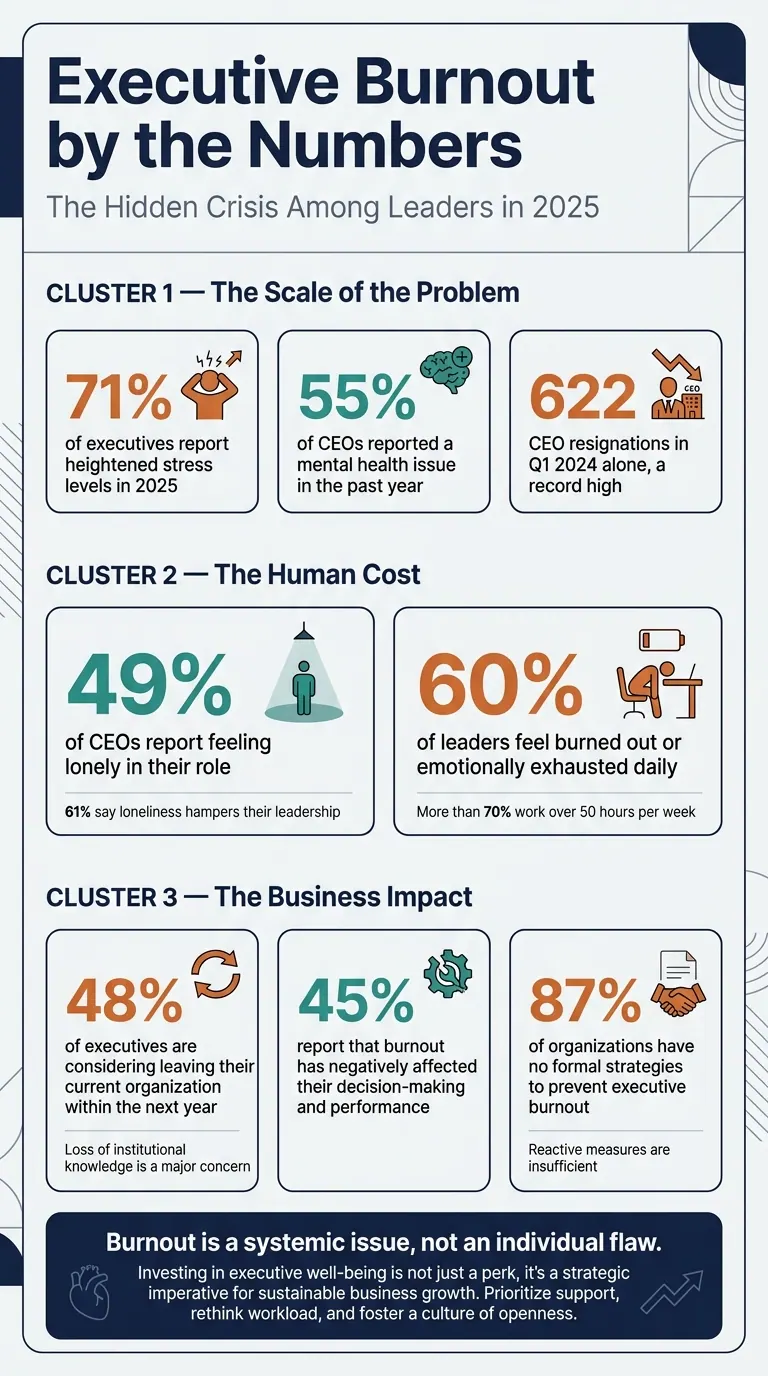
Executive Burnout by the Numbers: Key Statistics & Impact
Causes and Symptoms of Executive Burnout
What Drives Burnout in Leadership Roles
Executive burnout stems from several key factors.
One major culprit is decision fatigue. Leaders face an endless stream of high-stakes decisions every day - choices that impact employees, budgets, and entire organizations. This relentless cognitive demand wears down mental resources, making even small decisions feel overwhelming. Coupled with grueling 80–90-hour workweeks, especially during crises or periods of rapid growth, the physical toll becomes impossible to ignore.
Another significant factor is isolation. Nearly half of CEOs report feeling lonely in their roles, with 61% acknowledging that this loneliness hampers their leadership and creativity. Unlike other employees, executives often can't share their biggest stressors - like potential layoffs or financial challenges - with friends or family due to confidentiality concerns. Over time, this isolation compounds, adding to the burden.
A less obvious but equally impactful factor is identity fusion. This occurs when leaders tie their sense of self entirely to their professional role, so much so that a business setback feels like a personal failure. Dr. Christina Maslach, a psychology expert at UC Berkeley, explains:
"Executive burnout happens when leaders feel completely drained and overwhelmed over time, leading them to perform worse and disconnect from their work."
The challenges of the post-pandemic world have only heightened these pressures. Many leaders are now navigating their sixth straight year of intense workloads, while the rapid rise of AI introduces new stressors as they adapt to significant workforce changes. These ongoing demands take a toll, often showing up as emotional and cognitive symptoms that pave the way for deeper burnout.
Early and Advanced Warning Signs
One of the tricky things about executive burnout is how well it can be hidden. Many leaders continue to perform at a high level outwardly, even as they struggle internally.
The first signs often appear emotionally - cynicism, numbness, and a shorter fuse. These gradually lead to cognitive challenges like decision fatigue and a sense of being stretched too thin. Diana Chu, LMFT, highlights a key aspect of burnout in high achievers:
"Burnout doesn't require you to stop working. In fact, one of its hallmarks in high-achieving populations is the compulsive continuation of work despite depletion."
This tendency to push through exhaustion is what sets burnout apart from regular stress. While a stressed leader may slow down and recover after a tough project, a burned-out leader keeps pushing harder but achieves less. Physical symptoms like chronic fatigue, disrupted sleep, and visible exhaustion often follow as burnout progresses. In fact, nearly 60% of leaders report feeling "used up" by the end of their workday.
How Burnout Connects to Addiction and Mental Health
If left unchecked, burnout can spiral into severe mental health challenges and even addiction. Chronic stress often leads executives to rely on alcohol, prescription drugs, or other substances - a behavior known as high-functioning addiction, where outward success hides underlying struggles.
Mental health issues are also common among executives. Clinical depression affects 26% of leaders compared to 18% of the general workforce, a reflection of the relentless pressure tied to leadership roles. Anxiety disorders are similarly prevalent, often concealed beneath a polished exterior.
The financial impact of burnout reinforces the urgency of addressing it early. Organizations lose around $20,683 per executive annually in reduced productivity - five times the cost associated with non-managerial employees. Replacing a C-suite executive can cost between 200% and 400% of their annual salary. These figures highlight how burnout not only endangers personal well-being but also threatens organizational success, making effective and confidential recovery solutions essential for leaders.
sbb-itb-4b13a7c
Why Executives Avoid Treatment and Why Discretion Matters
Barriers to Accessing Treatment
Even when executives acknowledge burnout, many hesitate to seek help - not just due to pride but because of the very real risks involved. For instance, leaders of public companies face uncertainty around SEC disclosure rules. If a mental health condition is considered "material", it could trigger the need for an 8-K filing. Similarly, Directors and Officers (D&O) insurance renewals often involve checks with the Medical Information Bureau (MIB), where a mental health diagnosis might impact premiums, coverage terms, or even eligibility to serve on a board. During acquisitions or fundraising, even the fact that someone has sought treatment - regardless of the specifics - can come up in due diligence reviews.
Visibility is another major concern. In tightly connected professional circles, visiting a therapist’s office could risk unwanted exposure. There’s always the chance of running into a board member, journalist, or investor. Trevor Grossman, PhD, a Licensed Clinical Psychologist at CEREVITY, emphasizes this point:
"Discretion is not a style point at this seniority... it is a privacy-architecture decision with multi-decade consequences."
Additionally, many executives wrestle with what’s often called the "irreplaceability illusion." This is the belief that their absence, even temporarily, could lead to organizational collapse. When self-worth is tied closely to their professional role, seeking help can feel less like a strategic move and more like an admission of failure.
These obstacles highlight the importance of treatment models that ensure both effectiveness and absolute confidentiality.
What Discreet and Luxury Treatment Looks Like
Given these challenges, executives need treatment options that eliminate third-party exposure and bypass standard insurance processes. The distinguishing factor in executive-level care isn’t about luxury amenities - it’s about a system designed for privacy. Traditional therapy covered by insurance generates Explanation of Benefits (EOB) statements and MIB records, which could surface later during insurance applications or legal reviews. This is a sharp contrast to the privacy needs of high-level leaders.
Under the HITECH Act of 2009, patients paying entirely out-of-pocket can invoke the "Right to Restrict Disclosure", ensuring their treatment details remain private. This approach removes the risk of creating a permanent paper trail, making it the go-to option for executives seeking confidentiality.
| Feature | Standard Insurance Therapy | Executive Private-Pay Approach |
|---|---|---|
| Record Generation | Creates EOBs, MIB submissions, and billable diagnoses | No third-party records or insurance involvement |
| Privacy Focus | Protects therapy content under HIPAA | Ensures no records of the care exist |
| Scheduling | Standard business hours with limited flexibility | Concierge-level flexibility (evenings, weekends, short gaps) |
| Risk Management | Minimizes privacy concerns | Treats discretion as a fiduciary risk |
Flexibility in scheduling is another critical aspect of executive care. Concierge-level services, including evening or weekend appointments, cater to the demanding schedules of high-stakes leaders. Treatment centers are often chosen for their secluded locations, minimizing the chance of accidental exposure. Additionally, programs like Partial Hospitalization Programs (PHP) or Intensive Outpatient Programs (IOP) allow executives to balance their professional responsibilities while benefiting from peer support tailored to address unique challenges like heavy workloads and legacy planning.
Recovery Options Designed for Executives
Treatment Programs Built for Executives
Treatment programs tailored for executives are not just standard rehab programs with a few extra perks - they are clinically designed to address the unique challenges faced by high-performing professionals. These programs typically last 30–45 days and feature a low client-to-counselor ratio. They incorporate techniques like CBT (Cognitive Behavioral Therapy), DBT (Dialectical Behavioral Therapy), trauma-informed care, and executive coaching to tackle issues such as perfectionism, imposter syndrome, workaholism, and fear of failure.
To enhance the experience, peer groups are intentionally kept small and carefully selected, ensuring participants are surrounded by individuals who share similar leadership pressures and responsibilities.
As highlighted by Headwaters:
"Structured access to laptops and phones allows patients to manage essential obligations while fully engaging in clinical care."
These programs also provide secure workspaces, high-speed Wi-Fi, and flexible schedules, allowing executives to maintain their professional responsibilities while focusing on recovery.
In addition to these specialized features, successful recovery programs address co-occurring mental health challenges. By integrating care, they ensure that issues like burnout, anxiety, or depression are treated alongside other concerns, providing a holistic approach to healing.
Integrated Care for Full Recovery
Burnout rarely exists on its own. For many executives, it’s intertwined with conditions like anxiety, depression, or substance use, often stemming from years of chronic stress. Integrated care models are designed to address these issues simultaneously, providing psychiatric evaluations, individual and family therapy, leadership coaching, and specialized groups for chemical dependency. This concurrent approach is essential for achieving long-term recovery, as it prevents untreated conditions from undermining progress.
For those unable to commit to a full residential program, Partial Hospitalization Programs (PHP) and Intensive Outpatient Programs (IOP) offer structured clinical support. These step-down models help executives transition back to their leadership roles gradually, ensuring continuity of care without an abrupt end to treatment.
Protecting Privacy During Treatment
While integrated care is vital for recovery, maintaining confidentiality is equally critical. Effective executive programs prioritize privacy at every stage, implementing concierge-level security measures to protect participants’ reputations and personal information.
| Privacy Safeguard | How It Works |
|---|---|
| Staff NDAs | All staff members sign non-disclosure agreements to ensure confidentiality. |
| Private access | Dedicated entrances prevent unplanned interactions with other patients or visitors. |
| Secure communication | All correspondence, clinical or administrative, is encrypted. |
| Controlled device access | Scheduled use of devices like phones and laptops prioritizes recovery. |
| Absence narrative support | Clinical teams assist in crafting professional, credible explanations for time away. |
One standout service is absence narrative support. This involves creating a professional explanation for an executive’s leave, such as referring to it as a "health sabbatical", "strategic retreat", or a medical leave under FMLA. This strategy helps preserve their reputation with boards, investors, and coworkers while keeping treatment details private.
"Every member of our treatment team is specially trained to prioritize privacy from addiction recovery admission to discharge planning." - Altus Rehab
For professionals like physicians, attorneys, or pilots, managing licensure concerns is another key aspect. Many programs provide administrative advocacy, helping with medical board requirements, disability documentation, and structured return-to-work plans. These services ensure that seeking help doesn’t jeopardize their careers, allowing executives to complete treatment discreetly and return to their roles with their reputations intact.
Maintaining Recovery and Avoiding Relapse
Building a Healthier Approach to Leadership
Finishing treatment is a major achievement, but stepping back into the same environment that caused burnout - without making changes - is a recipe for relapse. The hard work truly starts when executives return to their roles.
One important shift is redefining success. Many executives tie their self-worth to long hours and output. However, sustainable leadership means adopting metrics that prioritize long-term performance and personal well-being. This isn't just an abstract idea; it's a practical necessity. In 2023, 70% of C-suite leaders said they were considering leaving their jobs for positions that better supported their health and well-being. This trend highlights that the old approach to leadership simply isn't working.
Another key to healthier leadership is structured delegation. As HR Executive and Consultant Kristin Durney explains:
"If you can't do it, delegate it to someone who can."
Delegation isn't just about lightening your workload - it also empowers your team to grow. The trick is to provide clear context, set expectations, offer support, and then step back. Leaders who cling to tasks out of habit or fear of losing control often find themselves on the fast track to burnout all over again.
Daily Wellness Practices That Support Recovery
Recovery is an ongoing process, built through consistent daily habits rather than a one-time treatment. Surprisingly, the basics - sleep, movement, and nutrition - play a bigger role than most executives realize. Chronic stress takes a serious toll on the body, with research linking it to conditions like atrial fibrillation (AFib), which can lead to strokes, blood clots, and even heart failure. Taking care of your physical health is not optional - it’s essential.
Treat self-care like any other meeting on your calendar. Simple practices like a morning routine, an evening wind-down, or a midday body scan can make a big difference. For example, taking three deep breaths, releasing tension, and checking your workload can help you spot stress before it spirals. Personal accountability is key, but having an accountability partner - whether a colleague or a friend - can provide that extra nudge to stay on track. This external support is invaluable and hard to replace.
These personal wellness habits form the backbone of recovery, complementing professional support systems.
Continued Support Through Therapy and Coaching
While self-care is crucial, therapy and coaching provide the structured guidance needed to sustain recovery. Combining executive coaching with clinical therapy addresses both leadership challenges and mental health issues, creating a well-rounded approach to recovery.
Different therapeutic methods can meet specific needs. Cognitive Behavioral Therapy (CBT) helps tackle distorted thinking, while Dialectical Behavior Therapy (DBT) focuses on managing intense emotions - both of which are common in high-pressure roles. For executives dealing with unresolved trauma, such as a public failure or crisis, Eye Movement Desensitization and Reprocessing (EMDR) has shown to be particularly effective. Teletherapy also offers a convenient way to maintain consistent sessions, even during business travel or hectic schedules, without adding extra stress.
The numbers speak for themselves: 55% of CEOs reported experiencing a mental health issue in the past year, and stress contributed to a record 622 CEO resignations in the first quarter of 2024. Licensed therapist Whitney Goodman advises:
"An executive should seek professional help for burnout when the burnout begins to negatively impact areas of their life."
Acting early - before a crisis hits - is what makes long-term recovery achievable. Recognizing the need for help sooner rather than later can be the difference between a setback and sustained progress.
The Ultimate Solution For Executive Burnout: Try Our Treatment Program Today!
Conclusion: Recognizing Burnout and Taking the First Step Toward Recovery
Burnout among executives isn’t a sign of weakness - it’s a serious medical and psychological challenge that requires prompt attention. Consider this: 55% of CEOs reported struggling with mental health issues in the past year, and an incredible 622 CEOs stepped down in just the first quarter of 2024. These numbers highlight the pressing need for private, specialized care tailored to the unique pressures faced by high-level leaders.
The key to recovery lies in identifying burnout before it spirals out of control. Warning signs like increased reliance on substances, poor decision-making, overwhelming anxiety, or a strong urge to withdraw shouldn’t be ignored. As one recovery expert aptly states:
"By seeking treatment discreetly and proactively, you demonstrate responsibility rather than weakness." - Reflections
Seeking confidential care doesn’t mean running from the problem - it means addressing it in a way that respects your privacy while tackling the root causes. Programs designed for discretion allow leaders to recover without jeopardizing their careers or reputations.
The road to recovery involves a combination of stabilization, evidence-based therapy, and ongoing support. From clinical treatment and executive coaching to adopting daily wellness practices, these steps help establish a solid foundation for both personal health and professional success. Prioritizing your well-being isn’t just an option - it’s the first step toward reclaiming your leadership and your life.
FAQs
How can I tell burnout from normal stress?
Burnout is a long-term state that doesn't go away with rest, unlike normal stress, which is short-lived and fades once the cause is addressed. If you’ve been feeling drained, emotionally distant, or overly cynical for weeks or even months, chances are you’re dealing with burnout - not just everyday stress.
How can I get help without it showing up on insurance records?
Accessing recovery services that prioritize privacy is possible through programs designed to bypass insurance involvement. These services adhere to strict confidentiality protocols, carefully manage communication to safeguard your identity, and provide tailored treatment options. Many high-discretion facilities accept direct payments from clients, ensuring your journey to recovery remains private and secure.
What treatment option fits if I can’t step away from work?
If taking a break from work isn't feasible, outpatient options can offer a practical solution. These include psychotherapy, stress management techniques, and practices like meditation or yoga. These methods are tailored to help you address burnout while continuing to meet your professional obligations. They provide the flexibility needed to balance self-care with your career.