
Eating Disorders in Perfectionist Leaders: Control, Image & Recovery

Perfectionist leaders often struggle with eating disorders due to their need for control and the pressure to maintain a flawless image. These traits, while driving professional success, can lead to harmful behaviors like restrictive eating or compulsive exercise. Women in leadership roles face additional societal pressures around appearance, amplifying these challenges.
Key Points:
- Control Issues: Food and exercise become areas where leaders seek mastery when professional demands feel overwhelming.
- Impact of Perfectionism: Traits like fear of mistakes, self-criticism, and high personal standards drive disordered eating behaviors.
- Common Patterns: Anorexia, bulimia, binge eating, and orthorexia often reflect a leader's perfectionist tendencies.
- Recovery Challenges: Perfectionism can persist during treatment, shifting focus to rigid recovery standards.
- Luxury Rehabilitation: High-profile leaders benefit from private, tailored recovery programs offering one-on-one therapy, flexible routines, and holistic therapies.
Solutions:
- Therapies: Cognitive Behavioral Therapy (CBT), Dialectical Behavior Therapy (DBT), and mindfulness-based approaches help address perfectionism and promote healthier coping mechanisms.
- Long-Term Stability: Flexible routines, self-compassion, and ongoing support are essential for maintaining recovery.
Breaking the cycle of perfectionism and disordered eating requires targeted care that addresses both behaviors and underlying mindsets. Leaders can channel their drive into recovery, building a balanced life beyond professional achievements.
Perfectionism in Leadership: Traits and Risks
What Defines a Perfectionist Leader
Perfectionist leaders hold themselves - and those around them - to exceptionally high standards. This mindset often shows up as workaholism, resistance to praise, and a constant feeling that their efforts are never quite enough.
Tana Luo, PhD, Director of Program Development at Equip, sheds light on the deeper roots of perfectionist tendencies:
"Temperament traits are present from birth, and they stick with a person throughout their life. When someone experiences internal or external stressors, those temperament traits may then get expressed in the form of eating disorder behaviors."
These traits influence how leaders approach their roles and can lead to unhealthy ways of coping with stress.
How Perfectionism Contributes to Eating Disorders
The relentless pursuit of perfection can spill over into eating behaviors, where control becomes a central theme. Research highlights perfectionism as a transdiagnostic process, meaning it plays a role in the development and maintenance of various eating disorders, including anorexia, bulimia, and binge-eating disorder.
Here’s how it works: leaders under immense pressure often channel their need for control into food and exercise. The "all-or-nothing" mindset that drives their professional success can lead to rigid dietary rules and intense self-criticism when those rules are broken. Notably, perfectionism and compulsive exercise account for 35.4% of the variance in eating disorder pathology.
The table below outlines how different aspects of perfectionism influence eating behaviors:
| Perfectionism Dimension | Leader Manifestations | Impact on Eating |
|---|---|---|
| Concern over Mistakes | Fear of professional failure; harsh self-criticism | Linked to binge eating and restrictive behaviors |
| Doubts about Actions | Persistent feeling that efforts fall short | Bridges emotional eating and restrictive habits |
| Personal Standards | Desire to excel in every area | Fuels obsessive monitoring of food and exercise |
Self-criticism is a major driver here. For perfectionist leaders, even minor setbacks can trigger intense shame, which may lead to disordered eating as a form of self-punishment. The stress of leadership further compounds the issue by raising cortisol levels, impairing decision-making, and pushing individuals toward unhealthy coping mechanisms. Women in leadership roles face an added layer of pressure due to societal expectations around the "thin ideal", which often ties physical appearance to professional credibility.
sbb-itb-4b13a7c
Control and Image in Disordered Eating
How Self-Worth and Performance Pressure Affect Food and Body Image
For many leaders, their bodies can become yet another benchmark of success. When professional achievements stumble, food intake often becomes a controllable outlet - a domain where mastery feels within reach. This tendency is closely tied to how high achievers equate their self-worth with their accomplishments. As mentioned earlier, restrictive eating can serve as a way to regain control when other areas of life feel uncertain.
For women in leadership roles, the pressure is even more intense. Societal expectations often tie appearance to credibility, compounding the struggle. This connection between image and self-worth can amplify disordered eating behaviors, as the pressure to "look the part" becomes overwhelming.
Common Eating Disorder Patterns in Perfectionist Leaders
The need for control shows up in specific eating disorder patterns, each reflecting perfectionist tendencies. Here's how these patterns typically manifest in leaders:
| Eating Disorder Pattern | Perfectionist Driver | How It Manifests in Leaders |
|---|---|---|
| Anorexia Nervosa | Desire for total control | Strict food restriction, framed as discipline or self-mastery |
| Bulimia Nervosa | Fear of failure and shame | Cycles of stress-driven binging, followed by purging to regain control |
| Binge Eating Disorder | Coping with chronic stress | Turning to comfort foods to momentarily ease intense stress |
| Orthorexia | Pursuit of "perfect" choices | Fixation on "clean" eating, mirroring professional standards of excellence |
Among high achievers, anorexia and bulimia are especially common. Both disorders are often fueled by an exaggerated focus on weight and body shape - an unhealthy belief that physical control equates to personal value. Tana Luo, PhD, Director of Program Development at Equip, explains:
"Both [anorexia and bulimia] are characterized by an overvaluation of weight and shape, so people who have a natural tendency to strive for high standards and be fearful of 'failing' to meet those standards may be at increased risk for both."
Bulimia, in particular, tends to follow a familiar pattern in leaders. As pressure builds, self-regulation falters, leading to episodes of binging. While the binging may offer brief relief, it’s often followed by shame and purging, creating a cycle aimed at restoring a sense of control.
Perfectionism, Military Discipline, and Eating Disorders: Breaking the Cycle of Toxic Achievement
Recognizing Warning Signs in High-Achieving Professionals
Eating disorder behaviors in high-achieving professionals often disguise themselves as traits like discipline and commitment. These behaviors reflect the same drive for control and perfection that many leaders exhibit, making them especially easy to miss.
Signs Visible in the Workplace
In the workplace, warning signs can often look like strengths. For example, a leader who consistently skips team lunches, pushes through injuries with relentless exercise, or sticks to an overly rigid daily routine might actually be struggling. Physical signs such as constant fatigue, unexplained weight changes, or feeling cold frequently can also indicate underlying issues.
Excessive exercise is another behavior to watch for. When working out becomes less about health and more about sticking to an inflexible routine - even during stressful times or when clearly exhausted - it may signal deeper concerns. Similarly, some leaders may use the demands of work travel as a way to hide restrictive eating habits, making their struggles even harder to detect.
Procrastination can also be a subtle clue. For someone who is usually a high achiever, sudden difficulty starting tasks isn’t about laziness. Instead, it may stem from perfectionism reaching a breaking point. The fear of not meeting impossibly high standards can cause task paralysis, making even small steps feel overwhelming.
While these outward signs are important to notice, many emotional and behavioral struggles remain hidden.
Hidden Emotional and Behavioral Patterns
In addition to visible behaviors, many perfectionist leaders wrestle with emotional challenges that are harder to see. They often carry feelings of shame and guilt tied to perceived failures - whether professional missteps or deviations from strict dietary rules.
One of the most telling patterns is the "shame cycle." For instance, a leader might binge eat in private as a way to cope with stress, only to feel intense guilt afterward. This guilt often leads to restrictive behaviors in an attempt to regain control. The resulting emotional swings - such as irritability, withdrawal, or sudden mood changes - might be the only outward sign of deeper struggles. Tana Luo, PhD, Director of Program Development at Equip, explains:
"Eating disorder behaviors may reduce someone's experience of distress, which then makes it more likely that they will continue to engage in those behaviors."
Another hidden pattern involves how food restriction becomes tied to a leader's identity. When they feel they’re falling short in other areas, tightly controlling food intake can feel like the one domain where they succeed. This reliance on restrictive eating as a source of self-worth creates a difficult cycle to break.
Observing "all-or-nothing" thinking is another key way to identify hidden distress. This might look like extreme shame over small mistakes, rigid food rules presented as healthy choices, or avoiding social activities that involve eating. These patterns, though subtle, can be strong indicators of deeper emotional struggles.
Luxury Rehabilitation for Perfectionist Leaders
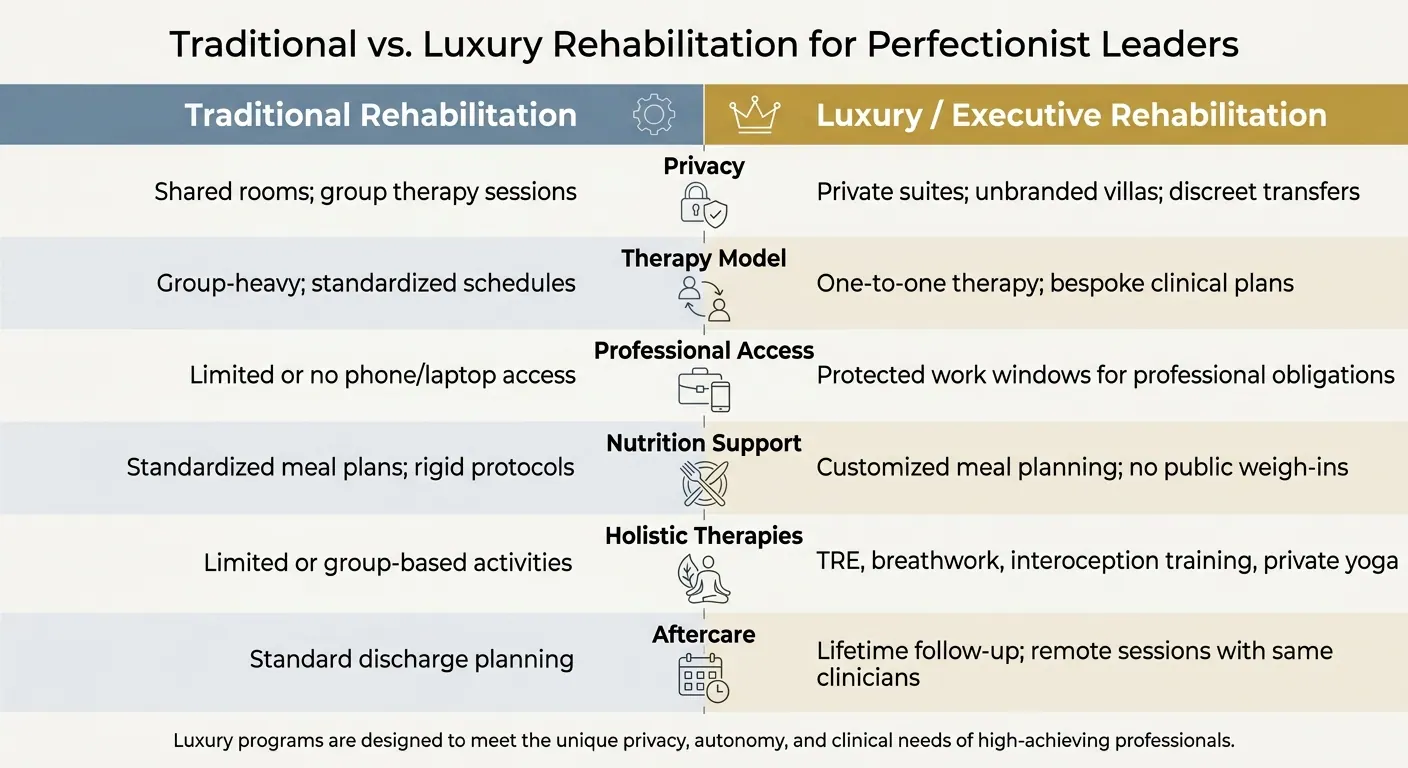
Traditional vs. Luxury Rehabilitation for Perfectionist Leaders
Luxury rehabilitation programs are carefully designed to address the unique challenges faced by perfectionist leaders, particularly their concerns about control and public image. For these individuals, the fear of exposure often outweighs their willingness to seek recovery. Traditional settings with shared rooms and group sessions simply don’t align with the privacy needs of high-profile leaders. As Sea Recovery explains:
"Anorexia nervosa is rarely 'about food.' It's often a way to manage pain, perfectionism, chaos, or identity loss."
By offering a secluded and personalized approach, luxury rehabilitation provides a safe space for leaders to begin their recovery journey.
Key Features of Luxury Rehabilitation Programs
Privacy is the cornerstone of these programs. Unlike clinical facilities, luxury rehabilitation centers are often located in unbranded, private residences - think coastal villas or serene estates. These settings, combined with discreet admissions and transfers, ensure confidentiality, allowing clients to focus on recovery without fear of reputational damage. This setup directly addresses the image-related pressures that often fuel disordered behaviors.
The treatment model also stands apart. Instead of rigid, group-focused schedules, luxury programs emphasize one-to-one therapy. Each client receives a tailored treatment plan that considers their unique stressors, history, and recovery pace. For leaders struggling with control-related eating disorders, collaborative meal planning replaces standardized dietary protocols, and public weigh-ins are eliminated. As Sea Recovery notes:
"We begin by understanding what the disorder is doing for you - then we replace it with safer regulation."
To accommodate their professional responsibilities, many programs include Executive Program structures. These allow clients to maintain limited work commitments through protected work windows, easing the anxiety of complete disconnection. Residential stays typically last between 28 days and six weeks or more, depending on the individual's clinical needs.
Luxury rehabilitation also incorporates holistic therapies, enhancing the recovery process. Techniques like Tension & Trauma Releasing Exercises (TRE), breathwork, and interoception training are offered alongside traditional clinical methods. Interoception training, in particular, helps leaders reconnect with internal signals like hunger and fatigue, gradually replacing external perfectionist-driven rules with a more intuitive sense of self-awareness.
Comparing Luxury Rehabilitation Options
The table below illustrates how luxury rehabilitation programs are uniquely equipped to meet the specific needs of perfectionist leaders compared to traditional options:
| Feature | Traditional Rehabilitation | Luxury/Executive Rehabilitation |
|---|---|---|
| Privacy | Shared rooms; group therapy sessions | Private suites; unbranded villas; discreet transfers |
| Therapy Model | Group-heavy; standardized schedules | One-to-one therapy; bespoke clinical plans |
| Professional Access | Limited or no phone/laptop access | Protected work windows for professional obligations |
| Nutrition Support | Standardized meal plans; rigid protocols | Customized meal planning; no public weigh-ins |
| Holistic Therapies | Limited or group-based activities | TRE, breathwork, interoception training, private yoga |
| Aftercare | Standard discharge planning | Lifetime follow-up; remote sessions with the same clinicians |
For high-achieving individuals, the ideal program goes beyond comfort - it must align with their need for autonomy and privacy. By addressing these critical factors, luxury rehabilitation programs remove many of the barriers that might otherwise prevent perfectionist leaders from seeking the help they need.
Treatment Methods for Perfectionism-Driven Eating Disorders
In luxury rehabilitation settings, treatment plans are carefully crafted to transform a leader's perfectionist tendencies into tools for recovery. These methods focus on addressing both disordered eating behaviors and the rigid mindset that fuels them. By blending cognitive, mindfulness-based, and relational therapies, perfectionist traits can be redirected toward healing.
Cognitive Behavioral Therapy (CBT) and Enhanced CBT
CBT-Enhanced (CBT-E) is specifically designed to tackle clinical perfectionism, which often sustains eating disorders. It works by addressing the overemphasis on weight, eating habits, and appearance. Similarly, CBT for Perfectionism (CBT-P) targets perfectionistic standards, helping to reduce disordered eating behaviors and compulsive exercise.
"Treatment can help people figure out how their traits can be used to stop meeting their eating disorder's goal and instead meet their own goals, like building a life worth living." - Tana Luo, PhD, Director of Program Development at Equip
Mindfulness-Based Interventions
Mindfulness-based therapies teach individuals to observe their thoughts without immediate reaction. This practice creates a much-needed pause between the urge to control and the actions that follow - an invaluable tool for perfectionist leaders.
Core self-compassion exercises help counter the harsh inner criticism that often drives restrictive eating. They also address all-or-nothing thinking, where a single slip from dietary rules might feel like complete failure. Over time, mindfulness enables leaders to make choices about food and body image based on personal values rather than external pressures. Acceptance and Commitment Therapy (ACT) is frequently paired with mindfulness to support this shift toward values-driven decisions.
Family-Based Therapy and Dialectical Behavior Therapy (DBT)
Family-based and dialectical approaches complement cognitive methods by focusing on emotional regulation and relational challenges. Dialectical Behavior Therapy (DBT) is particularly effective for leaders who struggle with intense anxiety when their high standards aren't met. It teaches emotional regulation and distress tolerance, offering practical tools to manage feelings of shame and self-punishment.
Relational isolation is another hurdle these therapies address. Many leaders distance themselves from loved ones to maintain rigid routines. Temperament-Based Therapy with Support (TBT-S) helps individuals reframe their perfectionistic traits as strengths that can aid recovery, rather than allowing these traits to perpetuate harmful behaviors.
"When my perfectionist trait is being expressed in a less productive way, that's actually when it fueled my eating disorder rigidity, or when it comes out as 'laziness' because it drives my procrastination or task paralysis." - Jamie Drago, Peer Mentor at Equip
The ultimate aim of these therapies isn’t to suppress a leader’s drive but to guide it toward recovery and a more balanced, meaningful life.
Maintaining Long-Term Stability After Treatment
Sustaining recovery over the long haul requires practical tools, a renewed sense of self, and ongoing support. After completing the personalized care offered in luxury rehabilitation, integrating these strategies into daily life is essential. These methods build on the tailored treatment approaches discussed earlier, helping individuals transition from intensive care to everyday resilience.
Building Flexible Daily Routines
For high achievers, rigid rules around food might feel natural - but they can also create risks for relapse, especially when control and image remain central to self-identity. Recovery isn’t about strict discipline. Instead, it’s about finding structured flexibility: a practical approach to eating that can handle the unpredictability of travel, tight deadlines, and other stressors.
One effective strategy is the "Rule of 3's": eating at least three meals and up to three snacks daily, with no more than three hours between each. This method helps regulate the body and curbs cycles of restriction and bingeing. By gradually reintroducing small amounts of previously avoided foods, it reduces their emotional intensity and breaks the all-or-nothing mindset. Over time, as physical hunger cues return, many shift to intuitive eating, guided by internal signals.
"If your plan only works under perfect conditions, it's not a sustainable plan." - Dr. Lara Zibarras, Psychologist and Binge Eating Coach
Redefining Identity Beyond Professional Achievement
For many leaders, self-worth is tied almost entirely to professional success. This narrow focus can make setbacks feel devastating, sometimes leading to a return to controlling food or appearance as coping mechanisms.
Recovery calls for building a life that extends beyond professional metrics. This involves identifying values, relationships, and hobbies that have nothing to do with work. Recognizing personal strengths outside of career achievements and engaging in activities where it’s okay to be a beginner are key steps. Shifting from a performance-driven mindset to one focused on growth helps transform setbacks into learning opportunities rather than failures.
"Perfectionism is a mask for vulnerability. It keeps us from showing others what we fear they will see about us." - Shanna A. Hocking, Principal of Hocking Leadership
It’s also important to reframe perfectionist traits. Qualities like attention to detail or dedication, once tied to rigidity, can be redirected toward activities that bring joy and foster connection, rather than reinforcing restrictive patterns.
Sustaining recovery also depends on maintaining professional support and personal connections.
Continued Therapy and Support Networks
Ongoing cognitive behavioral therapy (CBT) can help individuals recognize and counter the return of perfectionist tendencies - especially when concerns about control or image begin to creep back in and self-worth becomes tied to impossible standards. Combining CBT with virtual care and peer support offers a flexible solution for those with demanding schedules, helping to prevent relapses driven by perfectionism. For example, a peer mentor in January 2026 shared how reframing her perfectionism as "high attention to detail" allowed her to channel that trait into building a life beyond her disorder.
Peer support plays a crucial role in reducing the isolation often associated with leadership roles. Connecting with others who understand the pressures of high-stakes environments - without fear of judgment - can make it easier to address challenges before they grow into larger issues.
Conclusion: Tailored Care and Long-Term Recovery for Perfectionist Leaders
Eating disorders in perfectionist leaders often stem from linking self-worth to the pursuit of flawlessness. Breaking this connection is essential for recovery. As Springhill Medical Group explains, "A key part of addressing perfectionism is helping clients redefine success. Rather than striving for flawlessness, treatment encourages: Progress over perfection, Flexibility over rigidity, Emotional honesty over image maintenance, Self-acceptance over self-punishment."
While nutritional restoration is important, it’s not enough to resolve the deeper cognitive patterns that drive these disorders. Without addressing these underlying issues, the risk of relapse under professional stress remains high. Specialized care, such as Cognitive Behavioral Therapy (CBT), Dialectical Behavior Therapy (DBT), and Temperament-Based Therapy with Support (TBT-S), plays a crucial role. These therapies help leaders channel their natural strengths - like attention to detail, thoroughness, and dedication - toward healing rather than harmful behaviors.
"Treatment can help people figure out how their traits can be used to stop meeting their eating disorder's goal and instead meet their own goals, like building a life worth living outside of an eating disorder." - Tana Luo, PhD, Director of Program Development at Equip
The aim isn’t to eliminate perfectionism but to redirect it. When perfectionist tendencies are applied constructively, they can reduce feelings of paralysis and contribute to a more grounded professional identity - one that isn’t dependent on controlling food or appearance to feel competent. This shift transforms perfectionism from a rigid burden into a source of resilience.
For high-achieving leaders, these tailored approaches offer a way forward. With the right blend of personalized treatment, ongoing therapy, and a support system that understands the demands of leadership, long-term recovery becomes a realistic and sustainable goal.
FAQs
How can I tell if my “discipline” is actually an eating disorder?
To figure out if what you call "discipline" might actually be an eating disorder, take a closer look at your habits. Does it involve strict food rules, excessive control, or a fixation on weight and body image? If breaking these rules leaves you feeling overwhelmed with shame, anxiety, or harsh self-criticism, this could point to unhealthy thought patterns. Often, perfectionism fuels behaviors like severe food restriction or obsessive exercise. If these habits are causing emotional distress or interfering with your daily life, it’s important to reach out to a healthcare professional for guidance.
What treatments work best for perfectionism-driven eating disorders?
When perfectionism fuels eating disorders, treatment often focuses on tackling those perfectionist tendencies and encouraging a healthier relationship with food and body image. Cognitive-behavioral therapy (CBT) is a key approach, helping individuals identify and challenge rigid thought patterns tied to perfectionism. Meanwhile, mindfulness techniques play an important role in boosting self-awareness and easing the constant need for control.
For high-achieving individuals, such as executives or leaders, specialized programs offer a more tailored approach. These programs often combine therapy with personalized strategies that address their unique stressors and dig into the emotional roots of their eating behaviors. This dual focus helps these individuals manage the pressures of their demanding roles while working toward recovery.
What makes luxury rehab a better fit for high-profile leaders?
Luxury rehab programs cater specifically to high-profile leaders by offering a private, customized setting that emphasizes both confidentiality and comfort. These facilities often resemble upscale resorts, providing amenities alongside comprehensive care. They incorporate personalized therapies and mindfulness practices designed to address the unique challenges faced by high-achieving, perfectionist individuals. With access to highly skilled clinicians and exclusive support networks, these programs allow leaders to concentrate on their recovery without compromising their professional or personal reputation.