
High-Stakes Decision Fatigue: Restoring Mental Clarity for UHNW Executives

Decision fatigue occurs when repeated decision-making depletes mental energy, leading to poor judgment, impulsivity, or avoidance. For ultra-high-net-worth (UHNW) executives, the stakes are higher: every choice can impact global markets, reputations, and legacies. This mental strain often results in cognitive overload, ethical missteps, and reduced performance.
Key Takeaways:
- Causes: High-pressure decisions, isolation, and perfectionism drain mental energy.
- Effects: Leads to cautious or reactive decisions, irritability, and reduced focus.
- Signs: Avoidance, impulsivity, inability to delegate, and emotional exhaustion.
- Solutions:
- Prioritize critical decisions in the morning.
- Delegate routine tasks and automate workflows.
- Incorporate mindfulness, exercise, and better sleep routines.
- Use luxury mental health programs for advanced care.
By addressing decision fatigue with structured systems, mindfulness, and physical health strategies, UHNW executives can protect their mental clarity and sustain high performance.
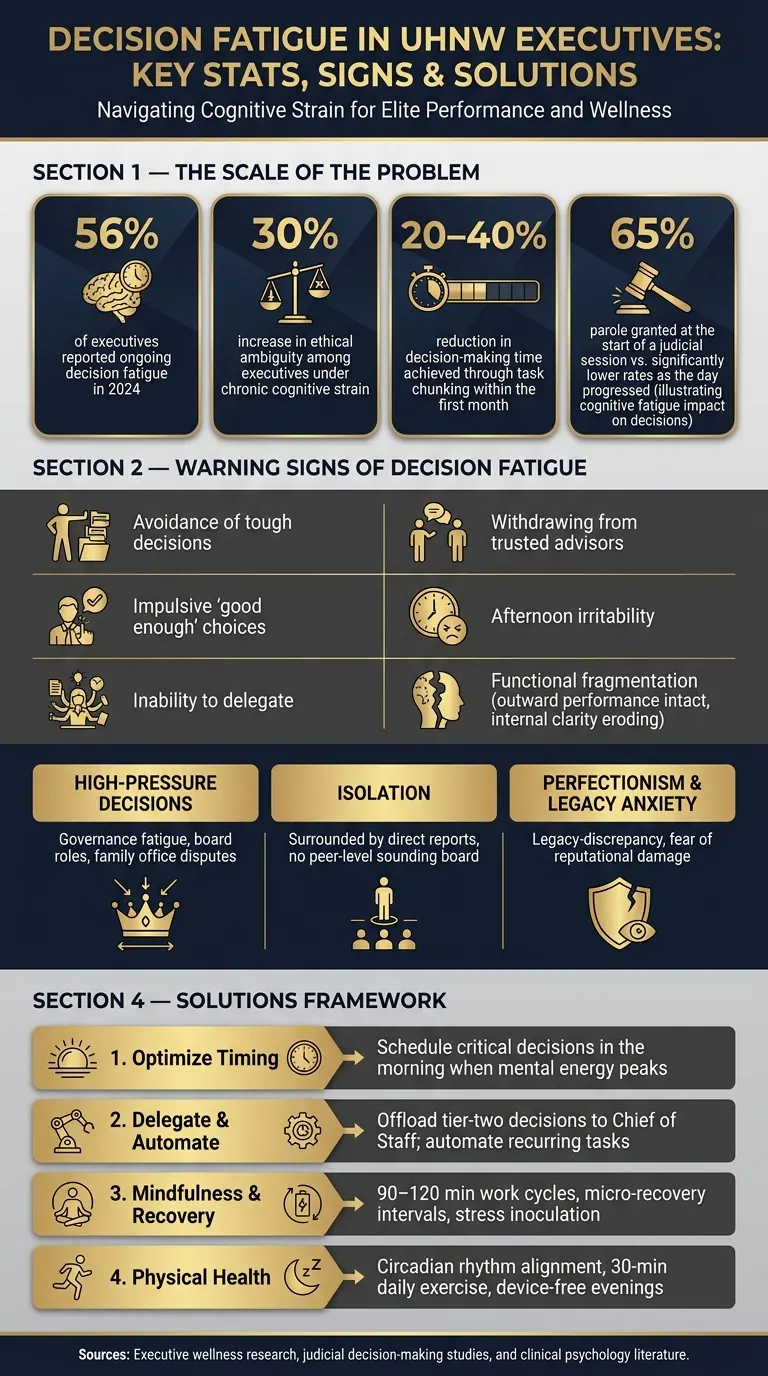
Decision Fatigue in UHNW Executives: Key Stats, Signs & Solutions
Key Stressors and Warning Signs
The Weight of High-Stakes Decisions
UHNW executives carry the immense burden of decisions that can ripple through markets, reputations, and even family dynamics. This constant pressure, amplified by "governance fatigue" - a result of managing board roles, intricate deals, and family office disputes - leads to significant mental exhaustion. Unlike mid-level professionals who can share challenges with colleagues, UHNW executives often work in isolation, surrounded by individuals who report directly to them. In 2024, over 56% of executives reported ongoing decision fatigue, with those under chronic cognitive strain showing a 30% increase in ethical ambiguity when making strategic choices.
Psychological and Relational Pressures
The stress of decision-making goes beyond quantity - it’s deeply tied to identity. Many UHNW executives see themselves as founders, deal-makers, or stewards of wealth. When business dynamics shift, even minor decisions can feel like existential threats rather than routine matters.
Perfectionism adds another layer of strain. The idea that every choice must be perfect forces the brain into overdrive, accelerating mental exhaustion. This is compounded by the fear of reputational damage, which can affect families and markets alike. The weight of legacy - balancing empire-building with creating a lasting culture - introduces what researchers call "legacy-discrepancy", a persistent undercurrent of anxiety that rarely fades.
"Stewardship begins with the mind of the steward. If one's own mental, emotional, and ethical governance collapses, so too does the family or institutional governance that depends on it." - Dr. Jerry Don Smith Jr., Clinical Psychologist and Wealth Ethicist
Recognizing the Warning Signs
Decision fatigue doesn’t always announce itself clearly. It often emerges through subtle behavioral and emotional changes that can be easy to miss. Common patterns include alternating between avoidance - delaying decisions due to overwhelm - and impulsivity, where depleted mental reserves lead to rushed, "good enough" choices.
Other red flags include an inability to delegate, marked by a growing need to oversee every detail personally, and withdrawing from trusted advisors for fear of judgment over mistakes. Struggling to switch off at night, being unusually irritable in the afternoon, or avoiding certain emails or conversations to dodge tough decisions are also key indicators. Perhaps the most concerning sign is "functional fragmentation" - when outward operations seem fine, but internal mission alignment and ethical clarity begin to erode.
"For UHNW leaders, the stakes are magnified: a single poorly timed decision may cascade through capital markets, reputational networks, and family dynamics." - Dr. Jerry Don Smith Jr., Clinical and Forensic Psychologist
Spotting these signs is crucial for taking steps to regain mental clarity and balance.
sbb-itb-4b13a7c
Strategies for Restoring Mental Clarity
Streamlining the Decision-Making Process
For ultra-high-net-worth (UHNW) individuals, decision-making can feel like an endless mental marathon. Simplifying this process is key to preserving mental clarity. One way to ease the burden is by reducing decision overload. Techniques like task chunking and focusing on one task at a time can cut decision-making time by 20–40% within the first month. Delegating routine decisions is another powerful way to conserve your mental energy.
"Every choice draws from a limited pool of mental energy; as that reservoir drains throughout a workday, executives become prone to poor judgment, impulsivity, avoidance, second-guessing, and mental exhaustion." - Cristin D. Smith, Spiritual Director & Life Coach, Saffron & Sage
To stay sharp, schedule your most complex decisions for the morning when your mind is freshest. Set up clear governance policies so only the truly critical problems - those your team cannot solve - land on your desk. Also, consider adopting satisficing, a strategy where you accept "good enough" outcomes for less critical decisions. This approach avoids the mental drain of striving for perfection in every choice.
Mindfulness and Stress Management
Mindfulness doesn’t have to mean lengthy meditation sessions. For busy executives, the focus should be on micro-recovery intervals - short periods of rest woven into the day. Incorporating 90–120 minute work cycles followed by brief recovery periods can help clear mental fatigue and improve focus. Even a quick 5-minute breathing exercise or body scan between meetings can reset your mental clarity.
Another technique is stress inoculation, which involves gradually exposing yourself to controlled high-pressure situations. This builds resilience and helps prevent emotional reactions from overriding rational thinking during critical moments. Pair this with intentional planning for high-stakes meetings to maintain composure and focus under pressure. For those looking to deepen these skills, Harvard Medical School's "The Science of Leadership: The Brain, Resilience, and Mindfulness" program offers a structured path to mastering these techniques.
Of course, mental clarity also depends on physical well-being, which brings us to the next critical pillar.
Sleep, Exercise, and Physical Health
Your mental performance is closely tied to your physical health. Prolonged decision-making stress can increase stress hormones, disrupt sleep patterns, and even raise long-term cardiovascular risks. These are not signs of weakness but rather indicators that your body and mind need recovery.
One of the most effective ways to support mental clarity is through circadian rhythm alignment. Going to bed and waking up at the same time each day - even when traveling across time zones - helps stabilize the hormonal cycles that influence cognitive function. Combine this with device-free time in the evening to allow for genuine mental and emotional recovery. The result? Better sleep and sharper decision-making the next day.
"Reduce the noise, protect your focus, and make your mind a tool, not a taskmaster." - Purdeep Sangha, CEO Performance Coach
Physical activity is just as important. Regular exercise supports the prefrontal cortex, the part of the brain most affected by decision fatigue. Even a simple 30-minute workout in the morning or a walk during lunch can have a profound effect on your ability to lead and think clearly. These small, consistent actions form the foundation for sustained performance and resilience in leadership.
Luxury Mental Health Solutions for UHNW Executives
What High-End Treatment Programs Offer
For some executives, achieving mental wellness requires more than traditional therapy or mindfulness practices. High-end mental health programs provide a comprehensive approach that goes far beyond standard care.
These programs incorporate cutting-edge diagnostics, customized clinical care, and advanced recovery treatments in a personalized setting. Tools like NeuroQuant® Brain MRI, genetic screening, continuous glucose monitoring, and VO2 max testing help detect early cognitive shifts. Meanwhile, therapies such as NAD+ IV infusions, photobiomodulation, and infrared sauna sessions with cold plunges aim to strengthen neurological health and resilience.
One example of this approach comes from Privé-Swiss:
"The Privé Swiss Brain Health & Optimal Longevity Program is the vanguard of personalized cognitive protection - integrating advanced diagnostics, metabolic optimization, psychiatry, sleep architecture engineering, stress biology, and executive-function performance into a single, highly individualized immersion." - Privé-Swiss
Privacy is a cornerstone of these programs. Some facilities limit their clientele to just one to three individuals at a time, while others offer in-home treatment with round-the-clock clinical and hospitality support.
"We intentionally limit the number of clients we work with at any given time. This allows for greater clinical availability, faster response to change or risk, higher levels of discretion, and a calmer, more contained therapeutic environment." - THE BALANCE Rehab Clinic
Flexible Treatment That Fits Demanding Schedules
Given the demanding schedules of executives, many programs offer hybrid models. These combine a short residential phase with remote follow-up care, ensuring intensive treatment without significant disruption to professional responsibilities. Centers also provide secure workspaces and controlled communication systems to maintain business continuity.
"Every member of our treatment team is specially trained to prioritize privacy from addiction recovery admission to discharge planning." - Altus Rehab
Post-residential care often includes three to six months of follow-up support. This can involve weekly virtual check-ins with clinicians and remote monitoring through wearable devices like the Oura Ring, ensuring ongoing care fits seamlessly into a busy lifestyle.
How Leading Rehabs Connects You to the Right Care

Navigating the options for high-end mental health care can be overwhelming, but Leading Rehabs simplifies the process. Their platform provides verified profiles of top-tier treatment centers, detailing therapies, clinical approaches, and conditions treated.
Rather than relying on promotional materials, Leading Rehabs offers the in-depth information you need to make an informed decision. Whether you're seeking extreme privacy, a flexible schedule, advanced diagnostics, or specialized trauma care, they help match you with the program that aligns with your needs.
Maintaining Mental Clarity After Treatment
Building Long-Term Mental Health Support
Finishing treatment is a big step, but staying mentally clear afterward takes continuous effort. The real challenge often begins when you're back in the thick of managing a business, overseeing finances, and leading teams.
One way to maintain this clarity is by surrounding yourself with a dependable network of professionals. This might include a therapist, a performance coach, and a trusted peer who understands the specific demands of your role. For executives who value privacy, concierge mental health services can be a great option. These services operate on a private-pay basis, bypassing insurance records that might come up during board-level reviews. Sessions can even take place in your home office or another familiar setting, making it easier to integrate support into your routine and sustain mental clarity.
"The leaders who perform at the highest level over sustained periods aren't the ones who push hardest - they're the ones who've invested in understanding themselves well enough to lead with clarity, resilience, and authentic presence." - Cerevity
This kind of support system doesn't just help you stay clear-headed; it also lays the groundwork for better operational strategies that protect your mental energy.
Using Governance Structures to Reduce Cognitive Load
Maintaining clarity isn't just about personal support - it's also about how you structure your work life. Creating formal systems to handle routine tasks can make a big difference.
For example, delegate "tier-two" decisions - like approvals, scheduling, and routine reporting - to a trusted Chief of Staff or well-trained team. This frees up your mental bandwidth for high-stakes decisions that truly demand your expertise. Another helpful strategy is prioritization scheduling. Research shows that mental energy is highest in the morning, so save your mornings for strategic decisions and push less critical tasks to later in the day. A study on judicial decision-making found that parole was granted around 65% of the time at the start of a session but dropped significantly as the day progressed, highlighting the impact of cognitive fatigue on decision quality.
Automating repetitive tasks - such as bill payments or recurring approvals - can also help reduce unnecessary mental strain, allowing you to maintain a more balanced and sustainable daily rhythm.
Tracking Early Signs of Decline
In addition to personal support and structured workflows, keeping an eye on your mental state is key to staying sharp over the long term. Decision fatigue often shows up as afternoon irritability, avoiding emails, or defaulting to overly cautious choices.
A simple system to monitor these early warning signs can be a game-changer. Quarterly check-ins on internal metrics - like your sense of purpose, sleep quality, and what clinicians call a "restorative margin" (the balance between what drains you and what recharges you) - can provide valuable insights. If you notice procrastination on important decisions, a sudden shift toward risk-averse behavior, or erratic delegation without clear instructions, treat these as signals to step back and recalibrate rather than dismissing them as minor setbacks.
How to Beat Decision Fatigue
Conclusion
Decision fatigue can significantly impact the performance of UHNW executives. When the prefrontal cortex is overworked, it leads to poor judgment, strained relationships, and the potential for personal strengths to backfire under pressure.
Acknowledging the issue is the first step toward improvement. The encouraging part? It’s something you can address. Adjustments like scheduling important decisions early in the day, delegating routine tasks, and automating workflows can help reduce mental strain. Coupled with psychological approaches that reshape how high-stakes decisions are viewed, these changes set the stage for sustained clarity and focus. Incorporating streamlined decision-making processes, mindfulness techniques, and tailored self-care ensures not just recovery but a pathway to long-lasting peak performance.
Dr. Jerry Don Smith Jr., Clinical Psychologist and Executive Coach, emphasizes:
"Without psychological mastery, wealth becomes a burden; with it, wealth becomes a platform for influence, impact, and fulfillment."
Access to quality mental health care - whether through structured programs or concierge services - plays a critical role in maintaining high performance. But the effort doesn’t end there. Building reliable support networks, implementing governance systems to safeguard mental bandwidth, and staying vigilant for early signs of strain are essential for ongoing success. These habits, maintained consistently, are key to thriving in the long run.
For UHNW executives, protecting mental clarity must be a priority. The strategies and systems outlined here offer the tools needed to safeguard both performance and well-being.
FAQs
How can I tell decision fatigue from burnout?
Decision fatigue and burnout may overlap in some ways, but they are fundamentally different experiences. Decision fatigue tends to be short-term and presents itself through irritability, avoiding decisions altogether, or feeling overwhelmed by even minor choices. Burnout, however, is a long-term state characterized by emotional exhaustion, a sense of detachment, and a decline in personal achievement, often accompanied by physical symptoms.
While decision fatigue can often be managed by adopting structured routines to reduce the number of choices you face daily, addressing burnout requires a deeper approach. This might include making lifestyle adjustments, seeking mental health support, and focusing on overall recovery.
What decisions should I stop making personally?
To tackle decision fatigue, ultra-high-net-worth (UHNW) executives can benefit from delegating or automating routine, low-priority decisions. This frees up mental bandwidth for the choices that truly matter. Letting go of perfectionism is also key - striving for "good enough" in less critical areas helps reduce unnecessary cognitive strain. Additionally, scheduling major decisions during peak mental clarity - often in the morning - can lead to better outcomes. These strategies not only lighten the mental load but also improve decision-making and overall endurance.
When is it time for a luxury mental health program?
High-powered executives often deal with relentless pressure, which can lead to decision fatigue, mental strain, and diminished focus. When these challenges begin to interfere with their performance or well-being, it’s time to consider specialized support.
Key warning signs include:
- Persistent irritability or mood swings
- Difficulty making decisions or chronic indecisiveness
- Avoidance of responsibilities or critical tasks
When these symptoms start to impact daily life or the ability to make strategic choices, a tailored mental health program can be a game-changer. These programs are designed to help executives regain clarity, manage stress effectively, and avoid burnout. In the long run, investing in such resources isn't just about well-being - it’s about maintaining resilience and peak performance in both personal and professional realms.